
GUEST COLUMN:
Noel Dolphin
Managing Director
Furrer+Frey

Rail has no shortage of good ideas. But what the sector often lacks is the place to viably test, refine and certify those ideas for a domestic and international market.
That is the commercial opportunity behind the Global Centre of Rail Excellence (GCRE) in South West Wales. For companies like ours, working on electrification, charge stations and emerging technologies that can get power to trains more efficiently, the challenge is to prove innovation quickly enough, robustly enough and in the kind of real-world conditions that give infrastructure owners, operators and regulators confidence.
At Furrer+Frey, we are focused on lowering the cost of the railway and making it more reliable. Ultimately, a strong product is one that can help more people travel by train, get them to work, school or hospital on time, support affordable ticket prices and move more freight around the country.
That is why we went to GCRE to support our work through the Innovation in Railway Construction programme. We wanted to test products in a real environment and demonstrate that they could lower costs and improve reliability. If we can show that clearly, we have something that can sell to clients not just in the UK, btu across the world.
Before GCRE was an option, that process was much more fragmented. For the Great Western electrification project to Cardiff, we carried out testing in Germany, Switzerland, Italy, Japan and parts of the UK. Those facilities were useful, but each tended to do individual things. Testing was spread out and sporadic, and it was far harder to bring people together and show them the product in a way that built confidence.
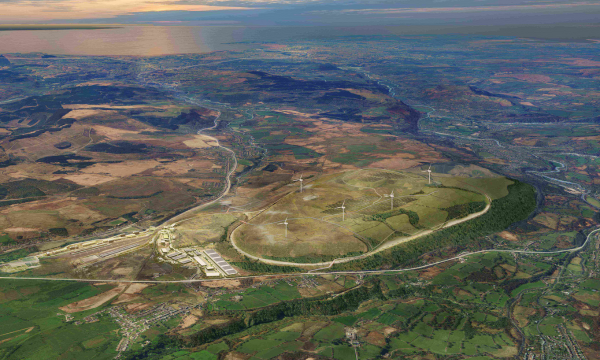
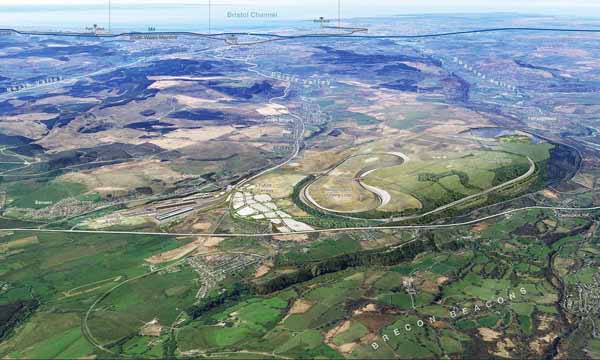
At GCRE, even though just a fraction of the overall vision for the facility is already developed and in use, we have already been able to test products. In fact, they are still there being tested now. The site allows you to take technology much further, in conditions that are difficult to replicate elsewhere. It is on the edge of a national park, exposed to everything the weather can throw at it. You can take people there in the snow, the rain and the sunshine, sometimes all on the same day, and show them how the product performs.
That has real commercial value. Clients need to know that a product will work on the railway. If it can survive on top of a mountain in South Wales, in some of the most testing conditions available, it gives them a level of assurance that is difficult to achieve through a conventional presentation or a laboratory trial.
This is clearly valuable for us, but the wider opportunity is much bigger than any one company. GCRE has the potential to become a rail innovation hub in the same way that the automotive sectors has developed around places such as Silverstone, or other areas have developed around research and development clusters in pharmaceuticals and computing.
There is already a significant rail base in Wales – more than many people realise. Transport for Wales has been highly innovative, including the development of the world’s largest train charge station at Taffs Well. There is also a depth of engineering experience, both inside and outside the railway, which can be brought into rail innovation.
In our own work at GCRE, we used cutting-edge composites, and much of that technology came from aerospace engineers based in Wales. That is exactly the sort of cross-sector collaboration that can strengthen the commercial proposition for the rail industry. Technologies developed in one sector can be tested, adapted and commercialised for another.
I have recently carried out work for the Office of Rail and Road looking at how the UK can bring more innovation into rail. I spoke to almost 100 suppliers from the UK and Europe, and one point came through very clearly. Many suppliers are reluctant to bring new products into the UK because they see testing and product approvals as too difficult.
One example has stayed with me. A supplier making diesel-powered tools wanted to move to battery-powered alternatives, which would have been better for the people using them and better for people living near railways and stations. But the UK was seen as such a headache for testing and approval that the company decided to stay with diesel.
That is the kind of barrier GCRE can help to address. It can provide a bridge between innovators and infrastructure, building on the work already being done by Transport for Wales and creating a more practical route for products to move from prototype to deployment.
For an SME, that route is crucial. We feel the innovation valley of death very clearly. You can have a prototype and a strong idea, but still struggle to commercialise it. GCRE has already shown that it can act as a conduit between those stages.
When we were carrying out demonstrations and product testing at GCRE, other projects were also being tested there, including graphene-reinforced concrete, self-healing concrete, AI-powered drone projects and a low-cost signalling system. Some of those have already scaled and become commercialised, including a signalling system now being used on the Heart of Wales line.
Without a facility like this, some of those projects may have struggled to progress. With it, they have a venue where they can be tested, demonstrated, challenged and scaled.
When we developed our project at GCRE, we needed a local supply chain. If something went wrong during testing, we needed spares, replacements or an engineer who could come out quickly. We could not wait weeks for something to be shipped from the other side of the world.
The same applies to many of the projects being tested there. If GCRE develops as an R&D cluster, the benefits will extend through the supply chain, creating demand for local engineering capability and supporting highly skilled employment in the region.
The project is now seeking private sector investment and a strategic partner to help realise its vision. For the rail industry, the commercial case is clear. GCRE offers a place where new technologies can be tested in real conditions, where clients can see products working, and where suppliers can move more confidently from prototype to market.
For Wales, it offers the chance to host a facility of European and international relevance. For rail, it offers something the industry needs: a practical route to prove innovation, reduce risk and bring better products into use.
Noel Dolphin talks about this and more on the Economy & Infrastructure Wales podcast. Listen here.