
GUEST COLUMN:
Noel Travers
CEO, Buckland Rail
Chair, Railway Industry Association

Every railway supplier knows the distance between a promising idea and a product in commercial service can be far longer than the track it will eventually run on.
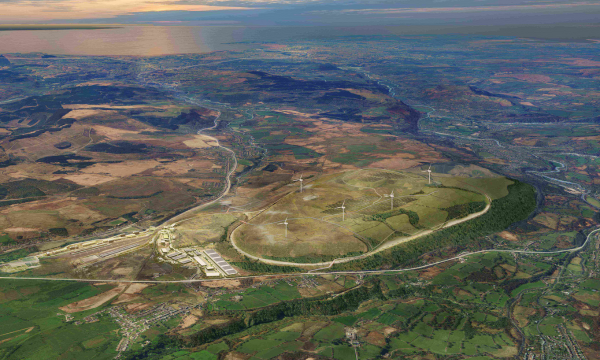
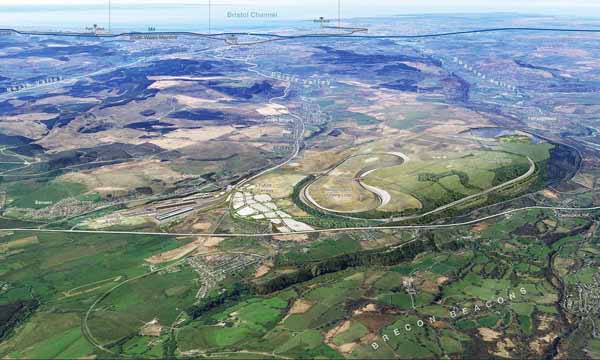
For smaller companies in particular, the hardest part is often not the invention itself. It is proving the product in conditions that give customers confidence, without asking the operational railway to absorb risk it cannot easily accommodate. That is why the development of the Global Centre of Rail Excellence (GCRE) in South West Wales could be so significant for the wider rail industry.
At Buckland Rail, we see that challenge from the perspective of businesses working directly in the supply chain. We are a collection of three railway businesses: Yellow Rail, which maintains and overhauls passenger and freight vehicles; Davis Wagon Services, which maintains freight wagons; and WH Davis, which designs and manufactures freight wagons. We are based in the Midlands, but we operate nationwide, including in South Wales.

One of the projects we are currently looking at is the development of high-speed freight wagons. At the moment, freight trains in the UK generally operate at either 60mph, or at 75mph for intermodal container trains. On a heavily constrained network which does not have much spare capacity, one way to increase capacity is to move freight trains faster so they can keep up more closely with passenger trains.
We are looking at the development of a freight wagon that could operate at up to 90mph or 100mph. That work is still at a very early stage, but if we design and manufacture such a product, the next challenge is clear. Taking it onto the mainline railway for testing will always be difficult.
Using an operating railway to test new products feels like the wrong thing to do. It is not a good use of constrained capacity, and innovation inevitably brings risk. The right place to test that risk, refine the product and generate confidence without adding pressure to the network is off network. GCRE would give us that opportunity.
That argument applies far beyond freight wagons. Through my role as Chair of the Railway Industry Association, I see the issue from across the supply chain. RIA is the primary trade body for the UK’s railway supply industry, representing more than 450 member companies, including more than 70 in our Wales and Western region. Those members range from multinational organisations to SMEs that manufacture equipment, provide services and build infrastructure for the rail network. Collectively, those companies employ many thousands of people.
For SMEs in particular, GCRE could be a major enabler. SMEs tend to be the source of much of the industry’s innovation. Larger companies can sometimes be more cautious because they are avoiding the risk that comes with innovation. Smaller companies are often the ones developing new solutions, products and technologies.
But for any SME working on a new idea, the biggest challenge is rarely coming up with the idea itself. It is realising that idea, turning it into a product that works in real conditions, and getting it into a position where a customer is willing to pay for it.
That requires testing and proof. It requires a safe environment where a company can develop a real-life example, invite clients to see it operating, and show that it does what the developer intended it to do. Without that proof, customers are being asked to take a risk on something unproven.
That is why SMEs, as primary developers of innovative solutions, could be among the parts of the supply chain that benefit most from an off-network testing facility like GCRE.
There is also a wider industry benefit from bringing companies together in one place. Other sectors show the value of this. In the automotive world, facilities and clusters such as Silverstone and MIRA bring like-minded industries together, allowing companies to see progress being made, share learning and build a community around innovation.
Rail could benefit from that same effect. It only takes one company to commercialise an idea successfully for others nearby to learn from that experience. SMEs are often very small organisations, relying on one or two key individuals to bring ideas to life. That can be a lonely environment. The ability to share space with other innovators, learn from them and understand how they have moved from drawing board to commercial service could be hugely positive.
The export opportunity should not be overlooked either. The rail supply chain is cyclical. There are periods of intense activity and quieter periods, and we have experienced one of those quieter periods recently for a number of reasons. One way for the supply chain to manage that cycle is to take products and services developed in the UK into international markets.
However, to realise these benefits, GCRE needs to be developed to its full potential. That will require the right backing from industry and government. One of the most important forms of support would be commitments from national, government-funded bodies and major rail organisations to use the facility.
If organisations such as Transport for London, the Department for Transport operator and Network Rail were able to guarantee a level of use, that would give the private sector greater confidence to take the risk of constructing the facility. Revenue from that initial use would then support the business case for further development.
That is the point we must not lose. If we want the benefits for the rail industry, and the economic benefits for Wales, we need to move from recognising the potential of GCRE to helping make it happen. The industry needs a place where innovation can be tested safely, where SMEs can prove their products, where exporters can build confidence, and where the operational railway is protected from unnecessary risk.
GCRE offers that opportunity. It now needs the backing to become the asset the industry needs.
Noel Travers talks about this and more on the Economy & Infrastructure Wales podcast. Listen here: