





Business activity at Welsh firms declined further in March, according to the latest Cymru Growth Tracker data from NatWest, with inflationary pressures sharpening substantially.
At 46.2 in March, the headline Wales Business Activity Index – a seasonally adjusted index that measures the month-on-month change in the combined output of the area's manufacturing and service sectors – was down from 49.3 in February and signalled a solid contraction in output levels. The fall in activity was the fastest in six months, with firms linking this to weaker demand conditions and uncertainty at customers following higher fuel and oil prices.
New orders also ticked down to a greater extent in March, with the rate of decrease the steepest since last September. Business confidence in the outlook for output also waned and dipped to the lowest in five months.
Meanwhile, rates of input cost and output charge inflation quickened notably on the month, reaching the sharpest since December 2022 and April 2025, respectively.
Jessica Shipman, Chair, NatWest Cymru Board, said:
“As we entered Quarter 1 we could see that Welsh business had momentum, but as expected the March data signalled more challenging demand conditions as war in the Middle East sparked greater hesitation among customers amid surging costs. Activity and new orders fell at sharper rates, as business confidence also waned steeply.
“The greatest development in the March survey period related to inflationary pressures, as hikes in fuel, transportation and energy costs pushed input prices up markedly. Despite subdued demand, firms were able to partially pass-through higher costs to customers. If strain on customer finances is exacerbated further, capacity to share higher cost burdens will likely be constrained, however.
“Meanwhile, Welsh businesses continued to cut workforce numbers steeply. Backlogs of work moved towards stabilisation, however, as supply disruptions and longer lead times for inputs and components showed signs of placing strain on firms' ability to process orders.”
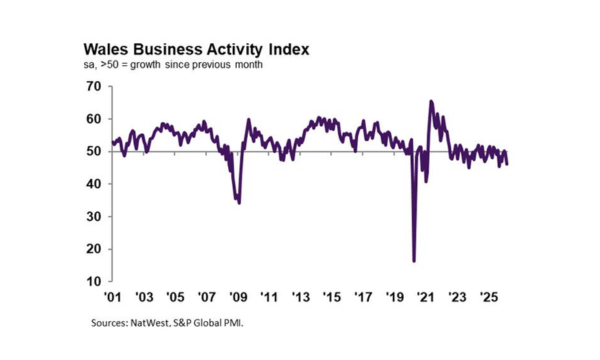
Business activity at Welsh companies contracted for the second month running and at the fastest pace since September 2025. In fact, the rate of decline was the steepest of the 12 monitored UK areas.
Welsh private sector firms indicated a strong contraction in new orders at the end of the first quarter. Anecdotal evidence often stated that customer uncertainty amid rising costs hampered new business inflows, with many holding off purchases. The rate of decline was the fastest in six months and the sharpest of the 12 monitored UK areas.
Meanwhile, customer hesitancy due to global economic conditions and rising costs also weighed on expectations for output over the next year in March. The degree of confidence slipped to the lowest since last October, with Welsh businesses among the least upbeat of the 12 monitored UK areas (more optimistic than only Scotland and Northern Ireland).
The latest data indicated a marked rise in cost burdens at Welsh private sector firms at the end of the first quarter. The pace of input price inflation quickened to the steepest since December 2022 and was well above the series average. Welsh firms recorded the second-sharpest rise in input costs of the 12 monitored UK areas, behind only Northern Ireland.
Businesses often sought to pass through higher costs to customers via a rise in selling prices in March. As such, the pace of charge inflation accelerated to the fastest since April 2025 and was comfortably above the series trend. The rate of increase was also quicker than the UK average.
Welsh businesses signalled a further contraction in headcounts at the end of the first quarter, as has been the case in each month since September 2024. The rate of job shedding was broadly unchanged from that seen in February and steep overall. Of the 12 monitored UK areas, only the North West recorded a sharper drop in workforce numbers.
At the same time, backlogs of work continued to fall in March. The level of outstanding business has now contracted on a monthly basis for almost four years, although the latest drop was the slowest in this period. The pace of decline was slightly softer than the UK average.