
GUEST COLUMN:
Mark John
Co-Founder
Tramshed Tech

Wales – and in this instance, South West Wales in particular – could be said to be on the brink of a pivotal moment in our economic story.
For generations, this region and this nation have been defined by heavy industry, coal, steel, and manufacturing. Those industries didn’t just shape our economy; they shaped our communities, our skills base and our identity. But, as we all know, that model has been changing for decades, and the pace of that change has accelerated in recent years – and is continuing to accelerate with the advent of AI and its increasing impact upon our economy and our communities.
The question we now face is not simply how we respond to industrial decline. It is how we actively build the next chapter, by focusing upon industrial growth.

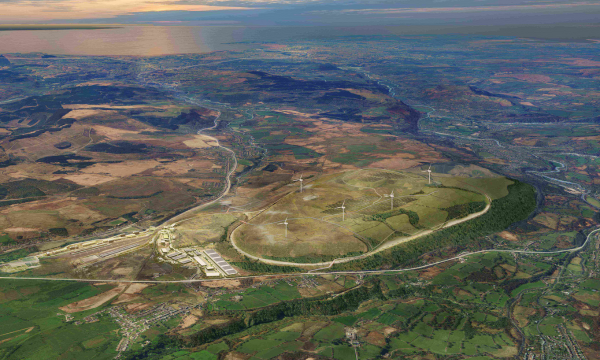
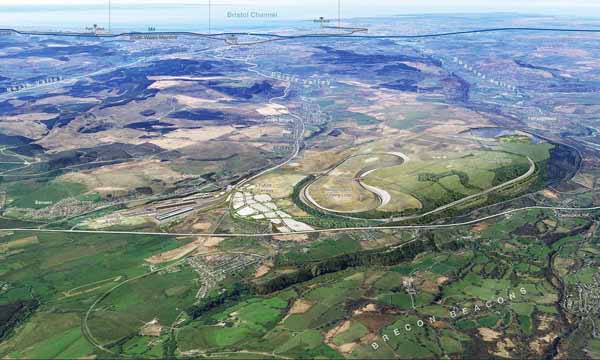
And that is why I believe the Global Centre of Rail Excellence (GCRE) represents one of the most significant infrastructure opportunities in our region today.
This is not about nostalgia for what we have lost. Nor is it about trying to recreate the past. It is about recognising that, with the GCRE project as a catalyst for growth in the South West Wales region, we have the potential to establish a centre for something new and innovative, something aligned with the industries and technologies that will define the future economy.
We are already seeing the direction of travel. Right across Wales, there is a growing focus on advanced manufacturing, energy resilience, materials innovation, renewable energy and digital capability – all viewed increasingly through the lens of AI. But these are not abstract concepts. They are real areas of opportunity and growth potential, where Wales can compete on both the national and international stages.
The challenge is how we translate that potential into tangible economic activity – into jobs, businesses, investment, particularly in areas most affected by that industrial transition.
This is where innovation projects like GCRE come into their own.
At its simplest level, GCRE is a major piece of infrastructure. But its real value lies more in what it enables. It provides a platform around which new industries and SME sector supply chains can grow and flourish. It creates a focal point for investment. And critically, it offers a pathway to replace lost employment with new, higher-value opportunities and entrepreneurial growth.
We should be clear about the scale of that challenge. Communities across Wales have seen significant job losses over time, and more recently in South West Wales in particular, through developments such as those affecting the local steel industry. These are not just economic statistics; they are huge social challenges, with real and far-reaching impacts on people, families and local communities.
But within that challenge lies a real opportunity.
We have a skilled workforce with deep industrial experience – skills in engineering, production, and problem-solving. With the right support and forward planning, those capabilities can be adapted and redeployed into our emerging sectors in Wales. The transition from heavy industry to high-value, technology-led activity is not automatic, but it is entirely achievable.
What is required is alignment.
Alignment between infrastructure investment and skills development. Alignment between public sector ambition and private sector opportunity. Alignment between regional priorities and national policy.
That is something we are looking to achieve through a pipeline of projects that we can present to the investment community, not just within Wales, but across the UK and to global investors.
GCRE sits firmly within that pipeline of innovative, transformative projects. It is exactly the kind of project that demonstrates what Wales has to offer: scale, ambition and relevance to future industries.
And, just as importantly, we need to be confident in making that case.
For too long, Wales has undersold its strengths. We have world-class capabilities, globally-recognised specialist strengths, embedded communities and significant growth opportunities, but we have not always articulated that story as clearly, or as loudly, as we should.
That is changing.
We need to be increasingly focused on positioning Wales as a place where investment can deliver both economic return and long-term impact. A place where major infrastructure projects are not just delivered, but where they become the foundation for wider growth.
Transport, in particular, plays a crucial role in that story. It is the thread that connects industries, communities and opportunities. And, in the case of GCRE, it has the potential to connect our industrial past with our economic future.
The industrial transition we are currently going through is not without its challenges. But it is also one of the most important opportunities we have had in a generation.
If we are serious about building a more resilient, productive and forward-looking economy in Wales, then we need to back some winners – and support projects that reflect that ambition.
And, when it comes to South West Wales, this is one of them.
Mark John talks about this and more in the Business News Wales Economy and Infrastructure Wales podcast episode GCRE – Improving Transport and Rebuilding Prosperity. Listen to the podcast here.