






A decision over the route of new electricity transmission infrastructure could unlock an additional £1.3 billion in spending with Welsh businesses, support 540 long-term jobs and generate almost £60 million a year in local economic benefits, according to new research.
The findings, published by RenewableUK Cymru, highlight the potential economic consequences of choosing a grid transmission route through Wales rather than an alternative that would bypass the country.
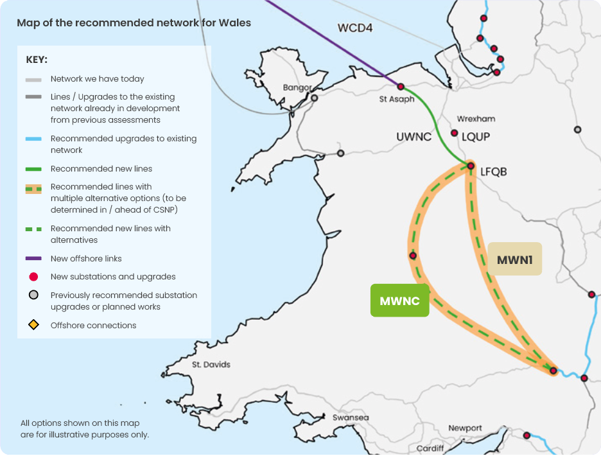
The independent analysis, undertaken by BiGGAR Economics, suggests that the decision could have significant implications for Wales’s renewable energy sector, business investment and wider economic growth.
The report, The Full Value of Connection, examines transmission options identified by the National Energy System Operator (NESO) as part of its Beyond 2030 – Electricity Transmission Update.
It concludes that the Western MWNC option, which would include a new substation in Mid Wales, offers the greatest opportunity to retain the economic benefits of future renewable energy development within Wales.
Under this option, up to 3GW of additional grid connection capacity could become available for Welsh onshore wind and solar projects, beyond the capacity required to transport electricity between the north and south.
This additional capacity would allow more renewable energy projects to connect to the network, creating opportunities for Welsh companies involved in the development, operation and maintenance of energy infrastructure.
Significantly, the analysis suggests that much of the potential £1.3 billion economic benefit would arise from the long-term operation of renewable energy projects rather than the initial construction of the transmission infrastructure.
The report estimates that projects enabled by the route could generate almost £60 million annually through business rates and community benefit arrangements, creating a recurring source of economic value for communities across Mid and North Wales.
It also identifies the potential to support 540 long-term jobs, with productivity levels estimated to be 62% higher than the Welsh average.
These findings come as the Welsh Government seeks to strengthen economic productivity, attract investment and develop industries capable of supporting higher-value employment.
However, the analysis warns that choosing the alternative MWN1 transmission route, which would bypass Wales, could restrict the capacity available for Welsh renewable energy developments, potentially limiting future investment and weakening the sector’s competitiveness.
Jessica Hooper, Director of RenewableUK Cymru, said:
“This decision is about far more than where pylons go. It is about whether Wales has the infrastructure it needs to build a stronger economy, and whether the value created stays here in Wales.
“A route through Wales, including a new substation in Mid Wales, would unlock renewable energy projects, jobs and sustained opportunities for Welsh businesses. But its true value would go further than the benefits we have been able to quantify from those projects alone.
“Energy infrastructure underpins the whole economy. Giving businesses confidence that the grid will be there when they need it can help them expand, invest and grow, attract new industries to Wales and support existing employers to decarbonise. That is why the choice of route matters – not only for the energy projects it enables, but for the wider ripple effect of prosperity it creates throughout Wales.”
The findings add further economic evidence to calls for the transmission route to pass through Wales.
Last month, a coalition of business and energy organisations wrote jointly to Cabinet Minister for Enterprise, Connectivity and Energy, Adam Price MS, highlighting the importance of the decision.
The signatories included the leaders of Powys and Ceredigion councils through the Mid Wales Growth Deal, representing areas that would host much of the proposed infrastructure.
Beyond renewable energy generation, the report also points to the wider economic importance of grid capacity in supporting business expansion, industrial decarbonisation and future investment.
For businesses considering new facilities, increased production or investment in low-carbon technologies, access to reliable electricity infrastructure is becoming an increasingly important factor in long-term planning.
The research suggests that the transmission decision therefore represents more than a choice between infrastructure routes. It could help determine how much future renewable energy investment Wales is able to accommodate and how much of the resulting economic value is retained within the Welsh economy.