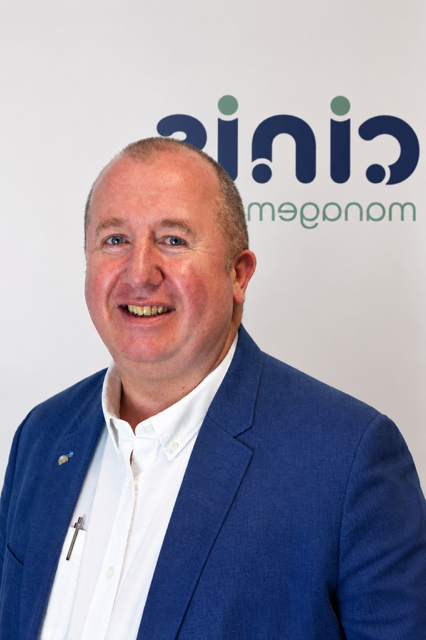
GUEST COLUMN:
Ivan Skidmore
Managing Director
Cinis Management Ltd

Most former industrial sites are judged by what needs to be cleared before the next use can begin. Aberthaw should also be judged by what has been left behind.
The former power station site holds an estimated 18 million tonnes of pulverised fuel ash, or PFA, the fine ash produced when pulverised coal is burned in a power station. It sits in a 50-metre-high mound across the site, and the consideration now for CCR Energy, which owns the site, is not only how that material is managed, but whether it can become the basis of a long-term industrial opportunity.
For me, the answer lies in treating Aberthaw not simply as a stockpile but as a place where materials processing, product manufacture, energy use and skills can be brought together. With the right permissions, technology and commercial structure, the site could become a working circular manufacturing operation, rather than a place where ash is simply dug out and moved elsewhere.

I have worked with ash for many years, including in technical, sales and advisory roles across cementitious and non-cementitious markets.
That background makes me interested not only in what the material could theoretically become, but in what can actually be done with it, at scale, with the right permissions, processing and commercial structure.
There are three important parts to the Aberthaw opportunity: time, quantity and quality. Time is valuable because the material is already there and there is enough of it to support a long-term plan. If a company is going to invest in processing technology, manufacturing or product development, it needs confidence that the raw material supply will last. At Aberthaw, the scale means a business could potentially look at a 20 or 30-year project, depending on how much material is used each year.
Quantity also changes the commercial picture. Small deposits can be useful, but they rarely justify significant investment. Eighteen million tonnes gives companies and investors something more substantial to work with. It allows people to think about processing, product manufacture, by-products, energy requirements and jobs, rather than just a short-term clearance exercise.
Quality is more nuanced. In this market, quality is in the eye of the beholder. The real question is not whether the ash is good or bad in the abstract, but what use it is being assessed for. Some applications may need limited processing. Others will require more sophisticated treatment. Material that is suitable for fill or ground engineering may not be suitable for reinforced concrete, while material processed for cementitious use may need to meet more demanding standards.
That is why Aberthaw should not be looked at through a single route. There are uses that could potentially be developed relatively quickly, subject to the right permissions and management. Ash can be used in geotechnical work, stabilisation, highways and block manufacture. In cementitious applications, demand is rising because of the carbon savings associated with replacing part of the cement content. These are not speculative markets; ash has been used in them for decades.
At the same time, the more innovative opportunities should not be dismissed. There is interest in rare earth elements, geopolymers, higher-value products and other technologies. Some of those may take time to prove and commercialise. That is why the best route is likely to be a portfolio approach: use some of the material in established markets, generate momentum and revenue, and keep space for research, demonstrators and future applications.
That approach also has implications for how the site itself is planned. Aberthaw should not simply be seen as a mound of material to be removed. It has infrastructure, access, space and proximity to universities and industrial knowledge. Those assets create the possibility of manufacturing on site, not just exporting material elsewhere.
A block plant could be part of the picture. So could a powder production facility for cementitious markets. If carbon is removed from the ash during processing, that high-carbon stream may have its own uses, potentially in areas such as asphalt, waste stabilisation, contaminated land treatment or as an input to other industrial processes. If energy is needed for processing and manufacturing, there may be a case for looking at how heat, power and other technologies sit alongside the materials operation.
That is what industrial symbiosis looks like in practice. It is not just a phrase about the circular economy. It is about designing the site so that one process can support another, and so that by-products from one activity do not automatically become waste. The ambition should be to use as much of the material and the site as possible, with each part helping strengthen the overall commercial case.
There will be hurdles. Planning and permitting can take time, and any extraction or processing plan would need to deal properly with dust, traffic, layout, local impact and environmental controls. These are not side issues. They will shape what is possible and how quickly progress can be made. But they should be addressed through a clear plan, not used as a reason to avoid ambition.
There is also a need for pragmatism. A site like Aberthaw will attract people with ideas, some of them credible and some less so. The task is to separate proven technologies and serious investment propositions from claims that are not ready for commercial reality. Conferences, industry networks and technical expertise can all help CCR Energy test those ideas against what is happening in the market globally.
The economic opportunity is not only in the sale of ash. It is in creating activity on a site that is currently quiet. Processing, manufacturing, engineering, energy systems and product development all bring people, skills and supply chains. These may include chemical, mechanical and electrical engineering roles, as well as practical jobs in plant operation, materials handling and construction product manufacture.
The most important thing is to get the sequencing right. Aberthaw should start with what can be done now, while building a site and a commercial model that can support what comes next. Established markets can create early momentum. Innovation can develop alongside them. Over time, the site could become an example of how a legacy industrial material can be turned into a long-term circular manufacturing opportunity.