






Six in 10 businesses back the home market as the best place to start, scale and grow, with 57 per cent believing the UK is becoming a more attractive place to list, new research suggests.
Barclays’ Business Prosperity Index, which analyses anonymised data from around one million UK business clients and research from 1,000 business leaders, reveals diverging behaviour, with larger firms increasing longer-term lending and smaller firms relying more on shorter-term liquidity financing in the last quarter of 2025.
While economic uncertainty remains the greatest challenge businesses are facing, confidence in the UK is resilient. Six in 10 (58 per cent) back the home market as the best place to start, scale and grow a business and 57 per cent believe the UK is becoming a more attractive place to list.
To support UK growth, Barclays has launched its 2026 Business Prosperity Fund, with a £22 billion lending commitment to help businesses invest and scale.
Key findings from the Q4 Index show:
- 93 per cent report higher trading costs, with energy, labour and supply chain expenses continuing to weigh on margins
- 80 per cent have passed on some cost increases to customers and 65 per cent expect to raise prices again this year
- Despite cost pressures, 86 per cent feel upbeat in their prospects and 65 per cent are confident in the strength of the UK economy
- 83 per cent expect revenues to rise in Q1 2026, with 27 per cent forecasting increases above 50 per cent
Barclays anonymised client data in Q4 shows cash inflows slipped 3.4 per cent year‑on‑year, signalling that subdued spending continues to weigh on income. At the same time, a two‑speed pattern of investment is emerging:
- Larger firms increased longer‑term borrowing by 8.7 per cent year-on-year, suggesting investment intentions remain despite broader uncertainty.
- Smaller firms however reduced their longer-term borrowing, while at the same time increasing overdraft usage by 2.5 per cent, pointing to tighter margins in the near-term.
This divergence between smaller and larger businesses mirrors an uneven confidence in the UK macroeconomic environment. Two thirds of large businesses (66 per cent) and over half of medium‑sized businesses (53 per cent) believe current economic conditions support long‑term growth, compared with just 12 per cent of micro businesses.
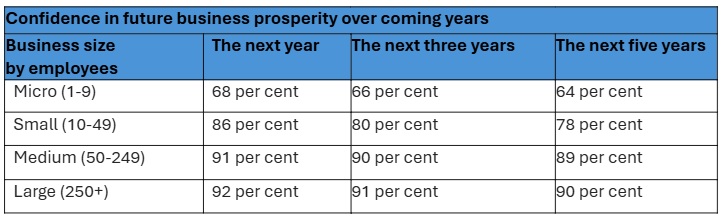
However, confidence in small business leaders’ own business prosperity over the coming year remains relatively high at 86 per cent, though this drops to 68 per cent for micros.
Abdul Qureshi, Managing Director of Barclays Business Banking, said:
“Smaller businesses have been operating cautiously, and the pressures they face are clear. Even so, many still see the UK as a place where they can innovate and grow.
“Our research shows a third of businesses believe the UK offers higher levels of innovation than other major markets, but over a quarter think it lags behind. These signals matter, and there is clearly more to be done. A priority now is helping smaller firms turn underlying confidence in their business into investment and tangible progress.”
Almost all businesses (93 per cent) report higher trading costs over the past year, with energy (85 per cent), labour (80 per cent) and supply chain expenses (78 per cent) continuing to weigh on margins.
In response, four in five (80 per cent) have passed on some cost increases to customers. On average, companies have passed on around 30 per cent, with larger firms more likely to do so (86 per cent).
Looking ahead, two in five businesses (65 per cent) plan further price rises this year, while only 17 per cent anticipate reductions. To maintain customer value, three in four (76 per cent) are turning to pricing innovations such as flexible payment terms (32 per cent), while others are focusing on efficiency measures to manage ongoing cost pressures.
85 per cent of all businesses cite energy costs as a pressure, rising to 90 per cent of medium-sized businesses, with over a third (34 per cent) reducing their energy usage to help manage costs. Reducing such operating costs is viewed as the most effective lever to support investment this year (37 per cent), rising to 44 per cent among large businesses.
Despite cost and confidence challenges, almost six in 10 businesses (58 per cent) believe that the UK is a more attractive place to start, scale and grow a business when compared to other major markets. Meanwhile, a similar proportion (59 per cent) say the UK is the best place to headquarter, compared to just 17 per cent and 14 per cent believing the contrary.
Additionally, London is seen as the best location to ultimately list or float, with 46 per cent of businesses preferring the UK to other markets and just 18 per cent seeing greater advantage abroad. Of those who agree, market reputation (43 per cent), access to capital (37 per cent) and a strong investor base (32 per cent) are the leading draws.
Forward-looking sentiment also remains broadly positive, with 55 per cent agreeing the UK is becoming a more attractive place to headquarter and 57 per cent saying it is becoming a more attractive place to list.
Matt Hammerstein, CEO of Barclays UK Corporate Bank, said:
“Even in a period marked by caution and cost pressure, businesses are showing a clear belief in the UK as a place to grow. That confidence is encouraging, but there’s still a job to do in turning it into action.
“Our role now is to help businesses bridge that gap, by pairing their ambition with the specialist support and financial firepower available through our 2026 Business Prosperity Fund.”