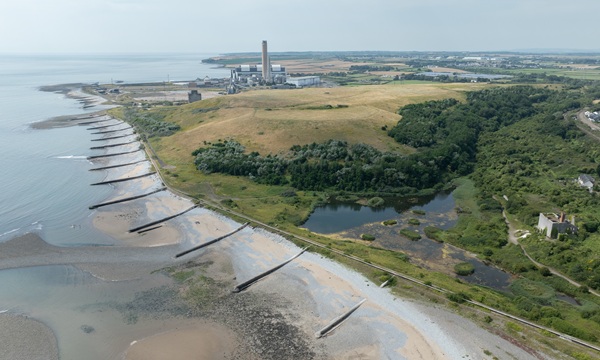
Work underway at the former Aberthaw Power Station could see South East Wales emerge as a centre for space and advanced technology, linking the region’s industrial heritage with the industries of the future.
A feasibility study led by the Open University is examining whether pulverised fuel ash (PFA) left over from Aberthaw’s coal-fired past could be used to simulate lunar dust, helping scientists test technologies for use on the Moon. The research, funded by the Welsh Government’s SMART Flexible Innovation Support programme and supported by CCR Energy, could pave the way for an Earth and Space Innovation Hub at the site.
The study will assess whether the PFA can replicate the properties of lunar soil and be used to create a controlled environment for research. It will also explore whether valuable materials could be recovered from the ash, applying techniques used in space resource extraction to waste materials left behind by Wales’ industrial past.
Speaking on the Cardiff Capital Region podcast series, produced in partnership with Business News Wales, Professor Mahesh Anand, Director of Research at the Open University’s School of Physical Sciences, said the work at Aberthaw shows how Wales can use its legacy of heavy industry to drive innovation in entirely new fields.
“When I first saw the site, it looked strikingly similar to the lunar surface,” he said.
“It’s a reminder that what we once saw as waste could hold the key to future technologies both on Earth and in space.”
Mahesh, who has spent his career studying Moon rocks brought back by the Apollo astronauts, said the project demonstrates how the principles of sustainability in space exploration – where every resource is reused – can be applied to life on Earth. He believes Aberthaw could become a testing ground for both lunar research and circular economy innovation, creating new opportunities for local industry and skills.
CCR Energy’s Innovation Lead, Dr Bettina Bockelmann-Evans, said the collaboration with the Open University fits into wider plans to turn Aberthaw into a low-carbon destination for research and development. She said the site could become a model for repurposing industrial land, bringing together clean energy generation, circular economy projects and space technology research under one vision.
Planning work for the wider Aberthaw redevelopment is expected to continue over the next two years, with smaller demonstration projects beginning sooner. Bettina said the aim is to have the first physical elements of the innovation hub in place within five years.
The work at Aberthaw is part of a wider transformation across Wales’s space sector. According to Space Wales, the national trade association for the industry, more than 100 organisations are now operating in space-related fields, employing more than 3,000 people.
Dr Rosie Cane, Cluster Manager at Space Wales, said the sector is growing rapidly, drawing on Wales’s strong academic base and industrial expertise. She said the mix of university research, manufacturing, data analysis and communications gives Wales a breadth of capability that few regions can match.
Space Wales works closely with the Welsh Government, the UK Space Agency and the nine Welsh universities through the Wales Academic Space Partnership, which helps align research and skills training with industry needs. The organisation’s 2022 strategy, Wales – A Sustainable Space Nation, identifies sustainability and skills as central to the next phase of growth.
Rosie said most of the companies operating in the sector are small and medium-sized enterprises, well placed to collaborate and respond quickly to emerging opportunities in areas such as satellite data, cybersecurity and advanced materials.
If the Aberthaw project proves successful, it could show how the sites that once powered the industrial age can now help drive a cleaner, high-tech future, the podcast heard.