





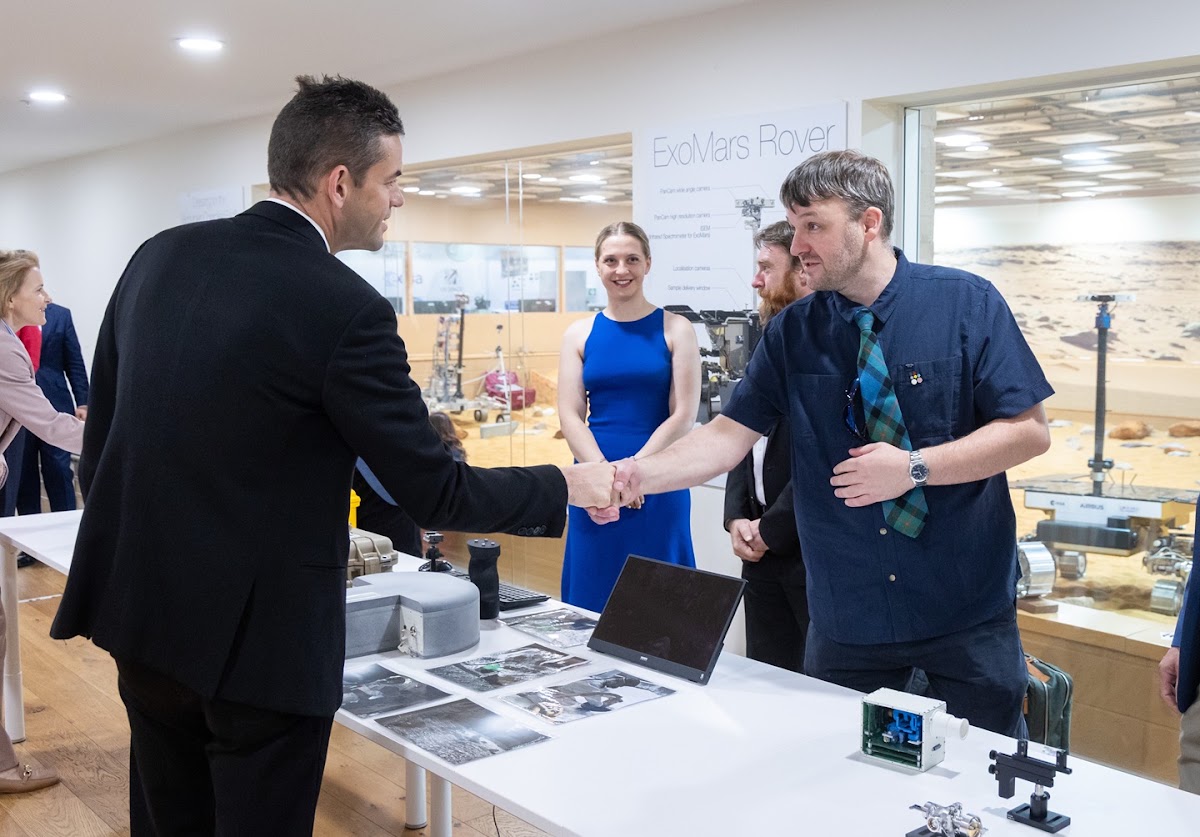
An academic from Aberystwyth University has met the Head of NASA to discuss his work on a Mars rover which will try to find signs of life on the red planet.
Jared Isaacman, who has flown into space more than once as a private astronaut, was appointed to lead the United States' Space Agency last year. He is responsible for leading his nation's efforts to return astronauts to the moon in two years time, and ultimately to Mars.
Dr Matt Gunn is one of the Aberystwyth University academics who leads work on a key instrument for a mission to Mars.
The infrared spectrometer, named Enfys, will be a part of the suite of remote sensing instruments onboard the ExoMars Rosalind Franklin Rover launching to the red planet in 2028.
The Rosalind Franklin Rover is part of the European Space Agency's ExoMars programme and Europe's first Mars rover.
Designed to be operated remotely across the planet's rugged terrain, it will drill up to two metres beneath the surface to analyse samples for organic compounds and biomarkers – potential signs of past or present life.
Enfys will work in tandem with PanCam – a camera system led by UCL's Mullard Space Science Laboratory – to pinpoint mineral targets.
These insights will enable the rover to select optimal drilling sites on the Martian surface, with samples analysed by other onboard instruments.
Dr Gunn met NASA Administrator Isaacman at a UK ExoMars stakeholder event at Airbus in Stevenage.
Dr Matt Gunn said:
“It was a real honour to meet Administrator Isaacman and present our work to him. Our work on the ExoMars rover places Aberystwyth, and Wales, at the heart of one of the most advanced planetary exploration projects in history. We are drawing on years of experience in space instrumentation development to push the boundaries of what's possible.
“Although several rovers have explored Mars, Rosalind Franklin will be the first to drill two metres below the sun-baked surface, where the chances of finding preserved evidence of life are highest. It's really exciting to contribute to a mission that could help unlock the secrets of life on Mars. So, it was a pleasure to discuss our work with the Head of NASA as well.”
The Aberystwyth-led team is currently focussing on constructing the flight model of Enfys, which will be fitted to the Rosalind Franklin Rover ahead of its journey to the red planet.
The development and testing of Enfys is led by Aberystwyth University, with support from Mullard Space Science Laboratory (MSSL) at UCL, STFC Rutherford Appleton Laboratory and Qioptiq Ltd.
Aberystwyth University was given greater responsibility for the mission after the cancellation of collaboration with Russia's Roscosmos following the invasion of Ukraine in 2022. Enfys' development was made possible by an additional £10.7 million from the UK Space Agency.