






Living standards in 11 top-performing UK cities and large towns rose more than twice as fast as those in Wales' largest cities.
Places including Warrington, Bristol, Barnsley and Brighton bucked the UK trend of slow growth in living standards since 2013, when the UK economy started recovering from the aftermath of the 2008 financial crisis, according to Cities Outlook 2026.
As a group, the top-performing cities and towns experienced economic growth of 27 per cent between 2013 and 2023 – compared to 18.4 per cent nationally – and delivered total real-terms disposable income growth of 5.2 per cent, compared to 2.4 per cent nationally.
Living standards in Wales’ largest cities rose on average by just 2.5 per cent, the research suggests.
Had Newport, Cardiff and Swansea experienced the same rate of disposable income growth as top performers since 2013, their residents would have pocketed an extra £3,500 on average in disposable income over that period.
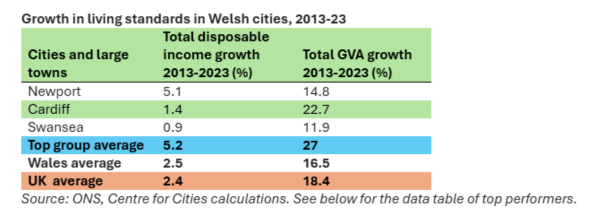
Places where real-terms living standards have risen at the slowest rate have missed out on pocketing larger sums. In Cardiff, economic growth outperformed the UK average, but this did not translate into higher growth in living standards. Real-terms disposable incomes there grew by just 1.4 per cent since 2013, and residents would have pocketed an extra £4,200 over the decade if the city had matched top-performing places. For Swansea – where real-terms disposable incomes grew by just 0.9 per cent since 2013 – the figure is £4,600.
Centre for Cities identifies three key areas for delivering faster living standards growth:
- Strengthening local economies, with a focus on growing ‘cutting-edge’ industries.
- Giving households better access to the opportunities of growth, by encouraging more people into work, providing skills support, and improving transport links.
- Reducing constraints on housing and commercial space so growing places can reach their potential.
Andrew Carter, Chief Executive of Centre for Cities, said:
“It is understandable that the UK Government has shifted its emphasis onto the cost of living in recent weeks, but ultimately it is stronger economic growth that raises household incomes. Without growth, cost-of-living fixes can only ever be temporary.
“Nationally, the last decade has delivered the same amount of growth in living standards as we typically experienced in a single year prior to 2008.
“In places like Warrington and Barnsley, economic growth has translated into higher household incomes and less deprivation. That isn’t accidental: it is shaped by policy choices on skills, transport, housing, and support for businesses.
“The UK Government's planning reforms, devolution agenda and Industrial Strategy are crucial for supporting growth in cities and delivering better living standards year after year. Cities need to support more jobs in the new economy – in sectors backed by the Industrial Strategy like life sciences, digital and AI. These jobs cluster in urban areas and generate benefits for those working in the ‘everyday economy’, too.
“As the Prime Minister has said, 2026 needs to be the year that ‘politics shows it can help again’. The test, at the end of this year, will be whether we are seeing more jobs, higher wages, and stronger local growth in more places across the country.”