







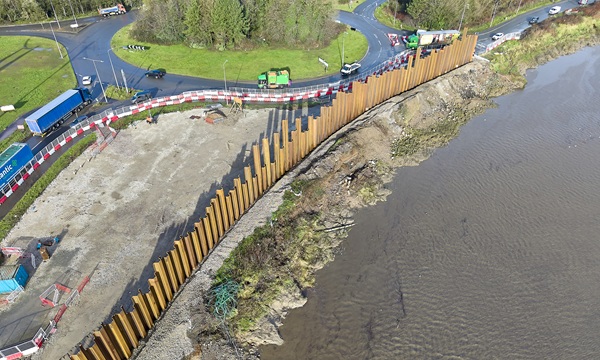
A major project to protect homes, businesses, key transport routes and vital infrastructure from the increasing threat of coastal flooding and erosion along the River Rhymney has passed a significant milestone, with more than 70% of the work now complete.
The scheme is now entering its final major construction phase, with essential piling works alongside Lamby Way due to begin at the end of September. This marks the last significant stage of the project that will affect the highway network and is a key step towards delivering long-term protection for Cardiff's coastline and nearby communities.
Cllr Dan De'Ath, Cabinet Member for Climate Change, Strategic Planning and Transport, said:
“The Coastal Protection Scheme is a major strategic investment that will help protect Cardiff's coastline from flooding and erosion for generations to come. As climate change increases the frequency and severity of extreme weather events, communities across South Wales are already experiencing significant impacts.
“Flood risk can have a major impact on residents and businesses, including making properties more difficult and expensive to insure. Once completed, this scheme will help protect 1,116 homes, 72 businesses and the Rover Way Travellers Site for the next 100 years, while also safeguarding key transport routes and strategic infrastructure.
“This is a major investment in Cardiff's resilience to climate change and in the long-term future of some of our most vulnerable coastal communities.”
Major elements of the project have already been completed, including the installation of rock armour along the River Rhymney and works to raise and maintain sea defences on the western side of the river. Construction is also continuing to raise existing coastal defence embankments along the coastline.
Extensive work has been undertaken to identify a way of carrying out the remaining works without having to close Lamby Way completely.
Following a comprehensive review, the Council has confirmed that the piling works can be delivered using lane closures and temporary traffic signals, allowing the road to remain open throughout construction. However, motorists should expect increased congestion and are strongly encouraged to use alternative routes where possible.
The original design for the scheme required a full closure of Lamby Way. However, following engagement with businesses and other stakeholders, a range of alternative options were explored, including carrying out the works from the water. These options were ultimately discounted due to environmental constraints, including requirements from Natural Resources Wales, protected habitats and the proximity of nearby nature reserves.
To enable the works to proceed while keeping Lamby Way open, specialist piling equipment has been sourced from Europe. Only one suitable machine is available to undertake the works, highlighting the considerable efforts made to minimise disruption to businesses, residents and road users. Despite strong progress on site, the project has faced a number of significant challenges. Delays in securing environmental approvals from Natural Resources Wales and the Welsh Government meant construction could not begin as quickly as originally planned, adding around nine months to the programme. As a result, the expected completion date has moved from October 2026 to August 2027.
The forecast cost of the scheme has increased from £35.9 million to £45.5 million. This reflects the impact of the approval delays, challenging ground conditions that required design changes, and revised construction methods introduced to avoid a full closure of Lamby Way and minimise disruption to businesses and road users.
Welsh Government funding remains fixed at £30.5 million through support for the borrowing required to deliver the scheme over a 25-year period. Earlier this year, the Council approved an additional £10 million capital allocation to help meet the increased project costs.
Cllr De'Ath added:
“Council officers continue to explore opportunities to reduce costs while ensuring the scheme delivers its original objectives.
“One option currently being assessed could reduce costs by replacing a proposed riverbank stabilisation solution with a monitoring and intervention approach, subject to further technical review. We remain fully committed to delivering this scheme and ensuring it provides the long-term protection Cardiff needs, while achieving the best possible value for public money.”
the evening of 20 September 2026, temporary traffic signals will be introduced on Lamby Way between the Southern Way and Lamby Way roundabouts, with piling works scheduled to begin on 5 October. The traffic management arrangements are expected to remain in place until late February 2027.
Traffic will continue to operate in both directions under temporary signals. A dedicated traffic management contractor will be on site to monitor conditions and adjust signal timings where necessary to help manage traffic flow and minimise congestion. Despite these measures, motorists are strongly advised to use alternative routes where possible.
The current programme for the Lamby Way works is:
- 20 September 2026 (evening/night): Installation of lane closures at Lamby Way roundabout.
- 21 September to 2 October 2026: Site preparation works, including vegetation clearance, removal of a redundant gas main, proof digging, creation of the working area and drainage works.
- 5 October to 11 December 2026: Piling works towards Lamby Way Bridge.
- 14 December to 23 December 2026: Night-time closures to remove piling equipment, partial removal of traffic management and commencement of pile cap installation.
- 24 December 2026 to 3 January 2027: Christmas shutdown with minimal traffic management in place.
- 4 January to 5 February 2027: Continued pile cap installation.
- 8 February to 26 February 2027: Installation of handrails and site demobilisation.
Once complete, the Cardiff Coastal Protection Scheme will provide long-term protection against coastal flooding and erosion, helping to safeguard communities, businesses, transport links and vital infrastructure while strengthening Cardiff's resilience to the impacts of climate change for decades to come.