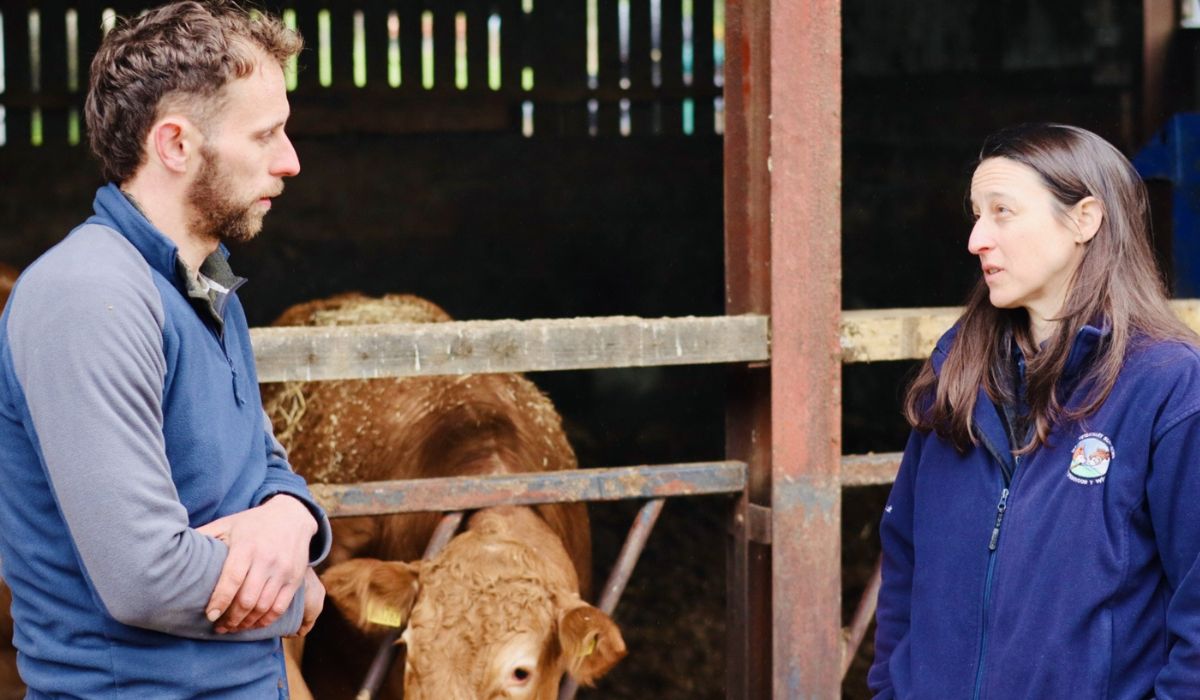
As the deadline to join the Sustainable Farming Scheme (SFS) approaches, the Animal Health Advance Programme is supporting vets to work confidently and consistently with their farm clients to deliver an Animal Health Improvement Cycle (AHIC) and a Biosecurity Assessment for Incoming Stock (BAIS) on farm.
The AHIC supports vets and farmers across Wales to work together on practical, farm specific improvements in animal health and welfare, helping to boost efficiency, productivity and long‑term resilience. It provides a structured framework that allows veterinary input to be focused on the issues that matter most to individual farm businesses.
With the support of Welsh Government, the Animal Health Advance Programme, led by Mentera, has trained 174 vets from 50 practices across Wales and the borders. Through this training, vets are better equipped to work alongside farmers, supporting them to meet the Animal Health and Welfare Universal Action (UA12) requirements within the Sustainable Farming Scheme.

Participating vets complete a full day of face‑to‑face training and a formal assessment, enabling them to deliver an AHIC and BAIS to farm clients in a consistent and quality‑assured way.
The AHIC is designed to be a constructive, evidence‑based and farm‑specific process, focused on addressing key health challenges rather than acting as a one‑off inspection. Over a 12‑month cycle, farmers and vets work collaboratively to assess priority health issues and agree targeted actions. These may include challenges such as lameness, mastitis or Johne’s disease, all of which can have a significant impact on productivity, profitability and animal health.
The cost and time of delivering an affective AHIC that will yield a return on investment will vary from farm to farm. This will depend on factors such as enterprise type, herd or flock size, existing health status and the depth of discussion needed to identify the most cost‑effective actions for that specific farm.
This investment, supported by local veterinary expertise, is designed to deliver long‑term value by identifying issues early, reducing avoidable costs and improving productivity and performance over time.
The AHIC forms part of the Universal Layer of the SFS, which means the Universal Baseline Payment is intended to cover the typical costs of delivering actions such as UA12. While costs will vary from farm to farm depending on size and the work involved, the Universal Layer is designed so farmers are not left funding an additional requirement themselves.
Experience from the AHIC pilot phase demonstrates the benefits of this targeted, data‑led approach. At Tyddyn Mawr Farm near Conwy, beef farmer Aled Jones worked with his vet Anna Williams from Wern Vets to review herd data as part of an AHIC.
Together, they identified high empty rates as a key priority. Targeted testing subsequently confirmed the presence of Johne’s disease in the herd, allowing a clear, long‑term plan to be put in place to improve herd health and productivity. Johne’s disease reduces fertility, milk yield and calf growth, leading to fewer calves sold and increased cow losses. SRUC research shows that, in a typical 100‑cow suckler herd, Johne’s disease can cost around £4,500 per year, largely through lost output and higher replacement costs.
Aled Jones said:
“The data confirmed what I already suspected, but putting clear actions in place to get on top of it was exactly what we needed. Having that focus gave us confidence that we’re tackling the right things and setting the suckler herd up better for the future.”
Anna Williams added:
“The AHIC is about focusing veterinary input where it can make the biggest difference. The farmer chooses the health challenge that matters most to them, and together we build practical actions around that. As farms and vets go through the cycle year on year, it becomes more efficient and delivers increasing value.”
Menna Davies, Animal Health Lead at Mentera, said:
“The ambition behind the AHIC is to help farms improve productivity, resilience and animal health outcomes over time. Identifying issues early and putting structured plans in place can prevent much higher costs down the line. The training programme ensures vets across Wales deliver AHICs consistently and in a way that offers good value for both farmers and the scheme.”
Farmers are encouraged to engage with their vet practices early and to prepare key records in advance of AHIC discussions. This helps make best use of veterinary time and keeps the process focused on outcomes rather than paperwork.
With further vet training events planned and an online Resource Hub in development, the Animal Health Advance Programme will continue to support vets as they work with farmers across Wales to meet the animal health and welfare requirements of the Sustainable Farming Scheme.