


GUEST COLUMN:
Dr Edward Thomas Jones
Senior Lecturer in Economics
The Albert Gubay Business School, Bangor University

Another Welsh company joining the FTSE 100 would be worth celebrating. It would not, however, prove that Welsh economic policy had succeeded.
That distinction matters after Adam Price, the Welsh Government’s Cabinet Minister for Enterprise, Connectivity and Energy, set out new ambitions for business growth in Wales.
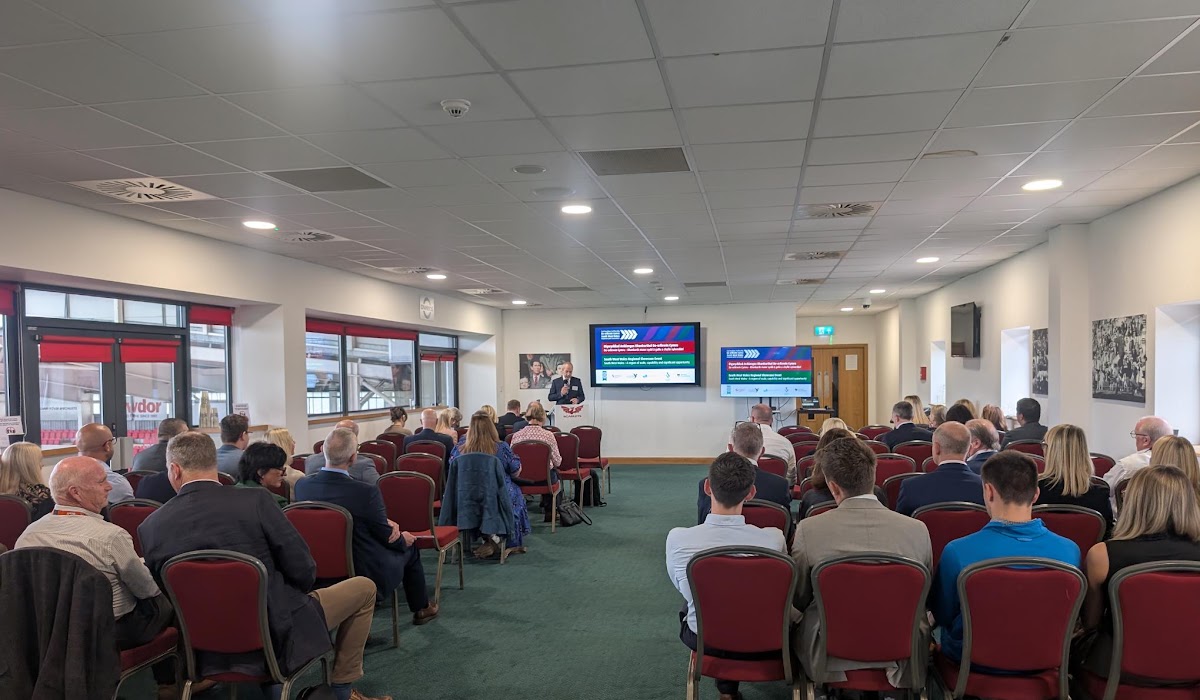
Speaking at Plaid Cymru’s conference on 3 October, Price set out two headline ambitions: 500 high-growth firms within ten years and an additional FTSE 100 company in Wales. He linked the two directly. Reach the 500, he argued, and Wales would “create the conditions” for another FTSE 100 company.
Alongside this comes Sbardun, a new Welsh Government programme initially supporting 20 firms with the ambition and potential to become medium-sized businesses. They will receive intensive support over two years, combining investment, experienced entrepreneurial support and help overcoming barriers to growth.
There is a clear economic rationale behind the scaling objective.
In 2025, 99.3 per cent of Welsh enterprises were small and medium-sized businesses, with microbusinesses alone accounting for 94.6 per cent. Large enterprises represented just 0.7 per cent of businesses but accounted for 37.7 per cent of employment in Wales, compared with 40.2 per cent across the UK.
Size alone does not make a business successful or productive. But larger firms tend, on average, to be more productive. Office for National Statistics (ONS) research points to several possible reasons for this, including economies of scale, a more specialised workforce and greater ability to invest in technology. However, the relationship varies across sectors and does not mean that growth automatically raises productivity.
That helps explain why policymakers are interested not simply in firm size, but in businesses capable of growing quickly. Recent research found that firms meeting one widely used definition of high growth represented less than one per cent of businesses but accounted for around 7.5 per cent of UK employment and turnover. Those firms also recorded higher average levels of investment.
When firms scale successfully, the effects can spread through the wider economy. More productive businesses have greater scope to support higher wages and better jobs, while growing firms can invest more, enter new markets and increase their demand from suppliers. At an economy-wide level, stronger employment, wages and profits also help broaden the tax base that ultimately supports public services.
Price captured the importance of building a larger group of growing businesses with the line: “A summit needs a mountain beneath it.” He explained that the 500 high-growth firms are the mountain: more businesses moving from small to medium-sized, more moving from medium to large, and from that deeper base more firms capable of reaching the summit.
The question is whether the FTSE 100 is the right way to define that summit.
Admiral Group, headquartered in Cardiff, is currently Wales’s only FTSE 100 company. It floated on the London Stock Exchange in 2004 and joined the index in 2007.
The FTSE 100 comprises the largest eligible UK-listed companies by market capitalisation. Its composition is reviewed quarterly, allowing companies to enter or leave as their market values change relative to one another. For investors, that provides a useful benchmark for the performance of large UK-listed companies. Those same characteristics limit its usefulness as a measure of economic development.
Imagine that, ten years from now, Wales has produced a company employing several thousand people, exporting around the world and investing heavily in research and development. Its senior management remains in Wales, its employees are well paid and a Welsh supply chain has grown around it.
There is only one problem. The company remains privately owned.
It could not join the FTSE 100.
Would anyone seriously conclude that Wales had failed to benefit from its success?
Aspiring to produce businesses of FTSE 100 scale is not the problem. Using index membership as an important marker of success is.
Companies can finance growth through public equity, retained profits, borrowing or private capital. A London Stock Exchange listing is not a prerequisite for becoming large, productive or internationally competitive.
FTSE membership is also relative. A Welsh company could enter the FTSE 100 and later return to the FTSE 250, the index containing the next 250 largest eligible UK-listed companies, because its market value had changed relative to others. Nothing fundamental need have altered about its employment in Wales, productivity, exports or investment.
Price himself offers a more useful test. In the same speech, he argued that “scale is a means, not an end” and that the ultimate objective is good jobs across Wales.
If so, the questions should be whether more Welsh firms are moving from small to medium-sized and from medium to large; whether they are becoming more productive, investing and exporting more; and whether growth is creating well-paid jobs while significant economic activity remains rooted in Wales.
Those measures are less headline-friendly than asking whether Wales has one FTSE 100 company or two. They tell us much more about whether the structure of the Welsh economy is changing.
Another Welsh FTSE 100 company would be a welcome symbol of business success. But if Wales builds a much deeper pool of productive firms that grow, invest, export and create good jobs, the more important transformation will have happened beneath the summit.