





Plans for a major tidal lagoon at Aberthaw capable of generating enough predictable renewable electricity to power the equivalent of around half a million homes have moved into the next stage of development.
Cardiff Capital Region (CCR) is funding and leading feasibility and initial development studies for a potential tidal lagoon on the South Wales coast, following joint work with the West of England Mayoral Combined Authority (WECA).
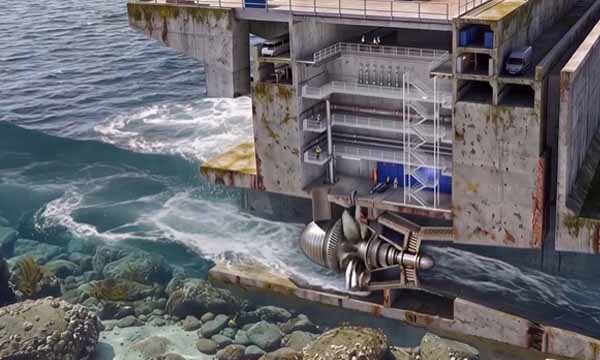
Initial analysis suggests an Aberthaw lagoon could have a generating capacity of around 600MW, producing approximately 1.3TWh of renewable electricity each year and operating for more than 100 years.
Economic analysis cited by CCR estimates that development and construction of the project could generate around £3.5 billion in UK economic value, while supporting thousands of jobs and creating opportunities for businesses and supply chains across South Wales, South West England and the wider UK.
Aberthaw emerged as the preferred location following work undertaken by CCR and WECA in response to recommendations from the independent Severn Estuary Commission.
Potential locations across the Bristol Channel and Severn Estuary were assessed, with Aberthaw identified as offering the best overall balance between energy generation potential and environmental, physical and infrastructure considerations.
The coastal area benefits from a strong tidal range, avoids major commercial shipping routes and is located close to existing energy infrastructure and industrial land.
The proposal could represent a significant new chapter for an area which has historically played an important role in South Wales' energy economy.
Unlike wind and solar generation, tidal movements can be predicted years in advance. CCR says this means tidal range energy could provide a long-term source of predictable low-carbon electricity capable of complementing other renewable technologies and contributing to energy security.
The Severn Estuary has one of the world's highest tidal ranges, reaching up to 14.5 metres.
However, CCR has stressed that no decision has been made to build the lagoon and there is currently no fixed design.
The next phase will examine whether an Aberthaw scheme can be technically feasible, environmentally responsible and commercially viable.
Work will include outline engineering design, environmental studies, site surveys, hydrodynamic modelling and commercial assessment.
Different potential configurations will be examined to understand their possible effects on water movement, sediment, habitats, species, flood risk, navigation and other uses of the estuary.
Environmental considerations are expected to play a central role in shaping any eventual design.
Rather than developing an engineering proposal first and subsequently assessing its environmental impact, CCR says environmental evidence and engineering will be developed together, helping determine the potential scale, location, alignment and operation of the lagoon.
The approach follows recommendations from the Severn Estuary Commission, established in 2024 to reassess the potential for tidal range energy.
The Commission engaged with more than 500 experts and stakeholders from more than 200 organisations before concluding that tidal range energy in the Severn was feasible. Rather than beginning with one of the largest possible schemes, it recommended developing a smaller
Commercial Demonstration Project capable of testing the technology at a commercially meaningful scale.
CCR and WECA will now engage with communities, environmental organisations, regulators, councils, ports, marine users, businesses, landowners, universities and the Welsh and UK governments as the work develops.
Previous work indicates that a tidal lagoon of this scale could take around a decade to move from early development to operation.
Any construction would depend on the project successfully progressing through engineering and environmental assessment, planning and consenting, financing and future investment decisions.