

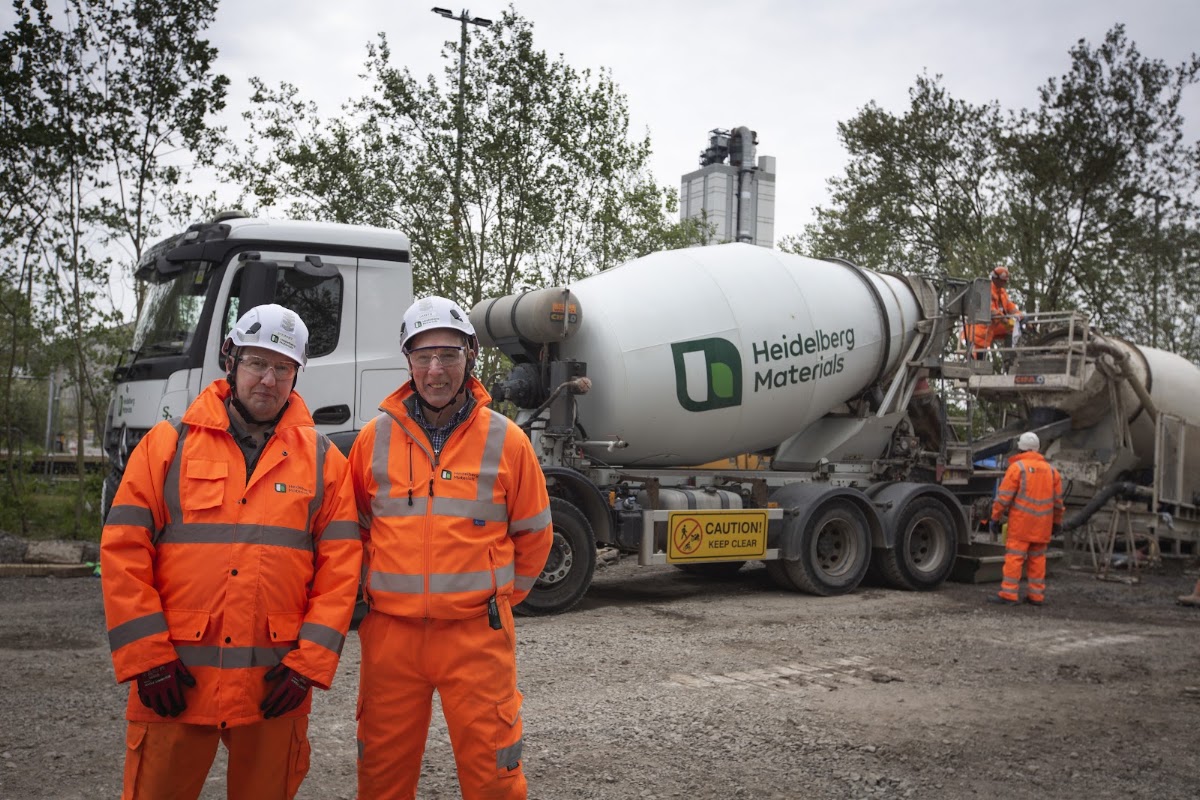
Groundwork is progressing well to build the UK’s first carbon capture facility at a cement works at Heidelberg Materials UK’s Padeswood site near Mold.
More than 60,000 tonnes of aggregate has been used to establish the working areas and over 600 concrete piles, containing around 5,000 cubic metres of concrete, have already been placed by two piling rigs, as part of the construction of a retaining wall.
All of the concrete being used to construct the carbon capture facility includes evoZero carbon captured near-zero cement. evoZero gains its sustainability credentials from the use of carbon capture and storage (CCS) at Heidelberg Materials’ Brevik plant in Norway and chain of custody models.
At present, an average of 80 construction workers are on site each day – a figure expected to double by the end of the year.
Gareth Price, Carbon Capture Project Director, said:
“We are delighted with the pace of construction of our Padeswood CCS project, which is a landmark project that firmly puts North Wales on the map as a forerunner of this technology.
“It is fantastic to watch as our plans turn into reality and we are using evoZero cement wherever possible in the construction of the new facility in order to lower the carbon impact of the project. There is also a symmetry to using a product produced using CCS to help build the infrastructure for another.”
This phase of the groundwork is being carried out through Worley which, along with Mitsubishi Heavy Industries, was awarded the EPCM (engineering, procurement and construction management) contract to build the Padeswood facility at the end of last year.
Completed groundwork on site includes:
- Installation of newt and security fencing.
- Diversion of overhead powerlines and cables.
- Removal of 25,000 tonnes of topsoil, which has been stockpiled for re-use in reinstatement works on site.
Padeswood CCS builds on the success of Brevik, which is designed to capture around 50 per cent of the plant’s CO₂ emissions (c.400,000 tonnes a year). The Padeswood facility is designed to capture almost all (around 95 per cent) of the carbon emissions from the existing cement works – around 800,000 tonnes a year once running at full capacity.