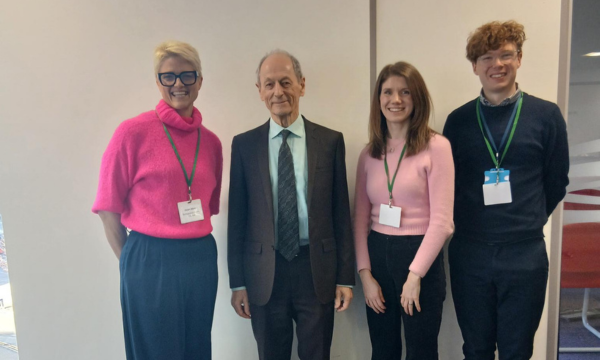





The latest Deloitte ‘State of the State’ report by Deloitte and the think tank Re:State draws on responses from an exclusive Ipsos UK poll and interviews with key public sector officials, to examine attitudes towards government and public services.
The survey asked respondents which issues should be the top priorities for improvement in the United Kingdom over the next few years. The ‘cost of living’ (chosen by 75% of people in Wales, with no change from last year), and ‘the NHS (chosen by 66%, down nine percentage points from the last survey) were the top two choices.
‘Immigration and border security’ saw the biggest increase from last year and is now the third biggest priority. It was chosen by 52% of respondents in Wales (up 8 ppts). Elsewhere, ‘the country’s infrastructure (e.g., roads, railways, broadband)’ was down 11 percentage points (to 31%), with ‘climate change’ also recording a significant drop of ten percentage points (to 28%).
Although the Welsh public remains more satisfied than not with some public services and local amenities, levels of satisfaction have dropped over the last five years.
The biggest decrease is in hospitals and healthcare. In 2020, 64% of Welsh people said they were satisfied with this service locally; that figure now stands at 30% (a drop of 34 percentage points). Nearly half (46%) are now dissatisfied, up from 14%.
The second highest level of dissatisfaction comes with ‘social care services for older and vulnerable people (41% dissatisfied vs. 20% satisfied).
However, compared to people in England, Wales showed higher levels of satisfaction in terms of ‘safety from crime’ (42% vs. 34% in England).
Respondents were asked to consider the use of Artificial Intelligence (AI) in public services. The survey showed 21% of Welsh people believed AI presents much more/more of an opportunity, versus the 35% that see it as a risk. A quarter (26%) are split, seeing it as just as much of an opportunity as a risk.
Similarly, a third (34%) of Welsh people trust the Welsh Government to use AI responsibly, but 44% do not.
A third (32%) highlighted that staff could spend less time on paperwork and administrative work, 29% cited the ability to analyse more information (e.g., trends and problem solving), and 26% mentioned faster delivery times.
On the other hand, half (51%) of the Welsh public noted there is the risk of reduced human contact, with a similar number (50%) identifying potential job losses as a risk. Close to half (46%) are concerned about the lack of human oversight.
Ian Howse, office senior partner for Wales at Deloitte, said:
“Our data clearly shows that the economy and the NHS are the priorities for the Welsh public. However, the government and public services in Wales face the same challenges as other nations of the UK: boosting economic growth, budget constraints and managing healthcare demands.
“While there are concerns regarding AI, particularly around human oversight and accountability, there is a clear recognition that new technologies could have a transformative effect on the way public services are delivered and managed in Wales. If this is harnessed effectively, there is every chance our survey will record a more optimistic and satisfied tone from the Welsh people.”
The survey asked Welsh respondents how they anticipate levels of tax and spend changing in the years to come. Over four in ten (43%) believe the UK will have higher levels of public spending than at present, as well as higher levels of tax and/or higher levels of public borrowing. Only 12% think that the UK will have lower taxes and/or lower public borrowing than at present, as well as lower levels of public spending.