The changing profile of businesses being bought and sold in Wales reflects a wider transformation of the Welsh economy away from its historic dependence on manufacturing and towards services.
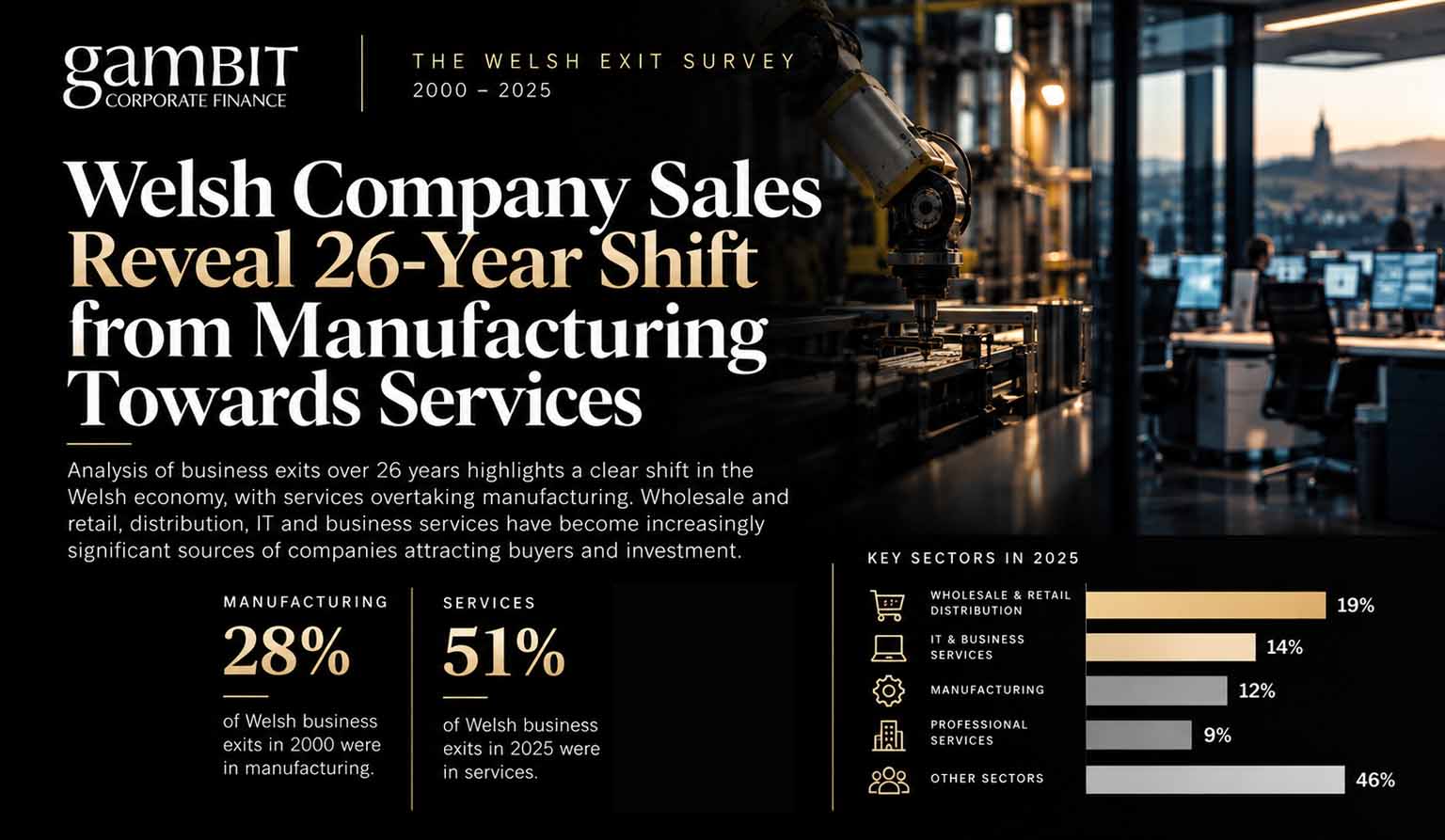
Service-sector business exits exceeded manufacturing transactions during the 26 years between 2000 and 2025, according to the latest Survey of Welsh Company Exits from Gambit Corporate Finance.
The corporate finance firm describes the trend as an indication of Wales’ shift from its traditional manufacturing heritage towards a more mature service economy.

Around 37% of service-sector exits recorded during the period were concentrated in wholesale and retail distribution, IT and business services.
Some have involved substantial transactions.
Comparison website GoCompare was sold to Future in 2020 in a deal valued at £594 million, while Penguin Portals Group was acquired by RVU during the same year for £508 million.
The figures demonstrate how technology, digital businesses and professional and business services have become an increasingly important part of the Welsh corporate landscape.
Manufacturing nevertheless continues to represent a substantial component of business exit activity.
Unlike services, manufacturing transactions were more widely distributed across different parts of Wales.
Machinery and equipment and food and drink were the most prominent manufacturing subsectors, together representing 29% of manufacturing exits by transaction volume.
Major deals highlighted in the research include the acquisition of Big Food Group by an investment consortium for £688 million in 2004 and the £100 million sale of Invertek Drives in 2019.
The change in transaction mix over the past quarter century provides an unusual perspective on the restructuring of the Welsh economy.
Economic change is often measured through employment, productivity, business births or gross value added.
Ownership transfers provide another lens.
An acquisition generally requires a buyer to believe that a business has strategic or financial value.
The companies attracting buyers can therefore reveal something about where commercially valuable businesses are being created and developed.
For Wales, that increasingly includes technology and knowledge-led services alongside its established manufacturing base.
It does not necessarily mean manufacturing has become less important.
Advanced manufacturing, engineering, food production and machinery remain important parts of the Welsh economy and of the acquisition market.
Instead, the figures point towards a broader economic base than existed at the beginning of the century.
That could become increasingly significant as artificial intelligence and digital technologies reshape both services and manufacturing.
The next phase may therefore be less about a simple distinction between the two sectors.
Technology is becoming embedded within manufacturers, while digital businesses increasingly depend on physical infrastructure, energy and specialist skills.
For policymakers seeking to understand the future Welsh economy, the 26-year exit data poses an interesting question:
What types of Welsh companies are attracting buyers today – and what does that tell us about the businesses Wales should be trying to grow tomorrow?