More Welsh businesses changed ownership in 2024 than at any point in the past quarter-century, according to a major analysis of company exits.
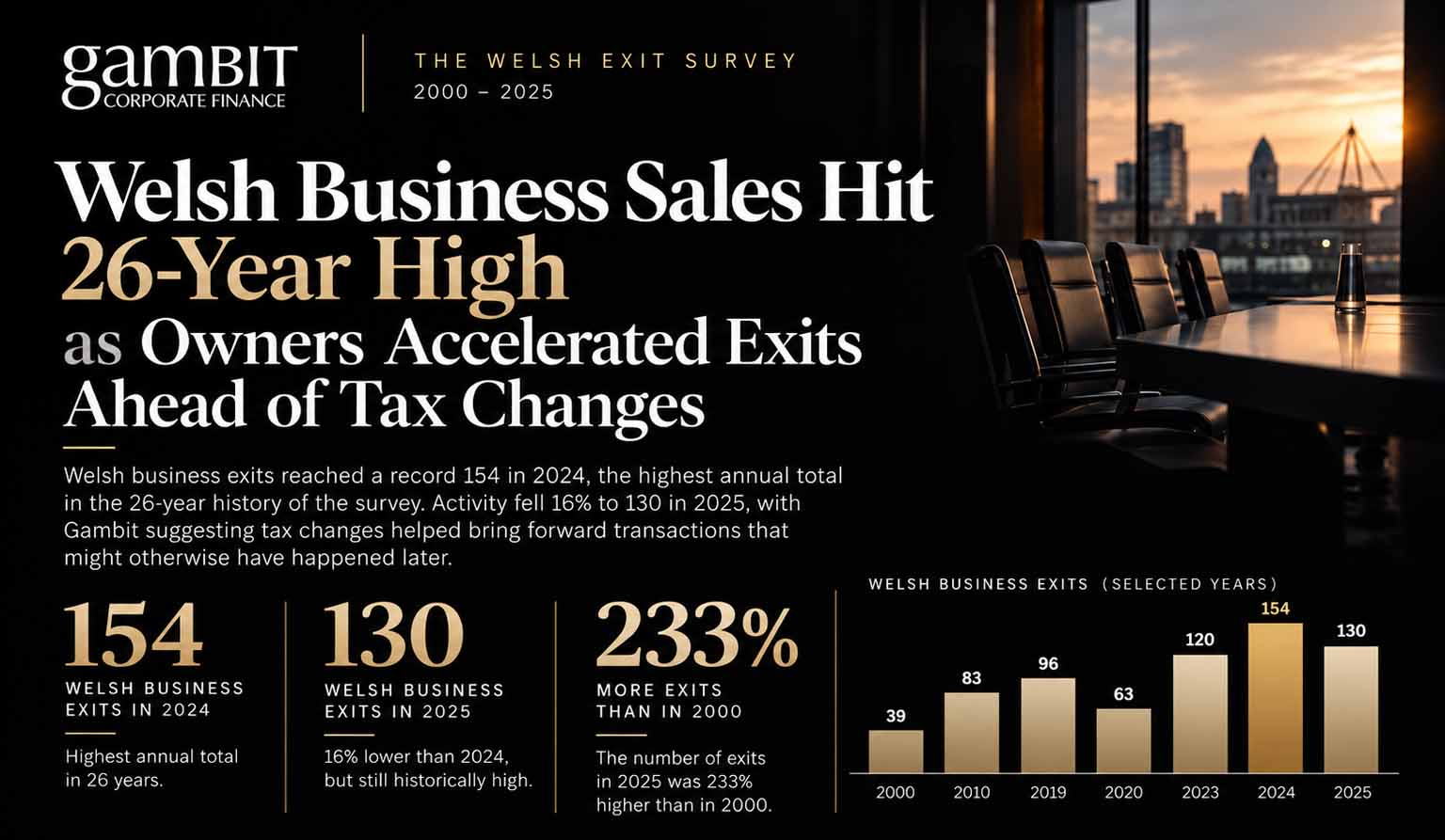
A total of 154 Welsh business exits were recorded during 2024, making it the busiest year in the 26-year history of Gambit Corporate Finance’s Survey of Welsh Company Exits.
The previous high had stood since 2007, when 136 exits were recorded during the credit boom immediately preceding the global financial crisis.

Activity subsequently eased during 2025, falling 16% to 130 exits, although that remained significantly above levels recorded during the early years of the survey.
Gambit believes tax changes announced in the October 2024 Budget contributed to the exceptional level of activity.
Capital Gains Tax rates increased following the Budget and the firm says its own transaction activity indicated that some business owners accelerated plans to sell rather than completing transactions a year or two later.
That means 2024’s record should be viewed partly as a timing effect rather than solely as evidence of a sudden underlying increase in the number of Welsh companies ready to sell.
However, the longer-term trend still points towards a significantly more active Welsh corporate transaction market.
The number of exits recorded in 2025 was 233% higher than in 2000, according to the survey.
Gambit’s research also shows how dramatically transaction activity has changed since the financial crisis.
Between 2003 and 2007, Wales experienced rising deal volumes against a backdrop of strong global economic growth, culminating in the previous record in 2007.
During the Great Recession between 2008 and 2011, annual deal volumes fell by an average of approximately 26%.
Activity began recovering from 2015 and had returned to pre-crash levels by 2019.
Covid then produced another sharp interruption.
The number of deals fell 35% in 2020 compared with 2019, before rebounding by 90% during 2021.
More recently, transaction volumes proved comparatively resilient to the economic shock following Russia’s invasion of Ukraine, changing by only around 1% in 2022 compared with the previous year.
Volumes declined by a further 15% in 2023 before increasing 40% in 2024 to reach the new record.
The figures illustrate the extent to which the market for buying and selling Welsh companies has matured since the beginning of the century.
Trade sales remain the dominant form of exit, accounting for 74% of transactions recorded over the 26-year period.
Management buy-outs and management buy-ins account for another 21%.
The latest figures also raise the question of what happens after the tax-driven acceleration of transactions seen in 2024.
The reduction from 154 deals in 2024 to 130 in 2025 may represent some of the market returning to more normal conditions after transactions were brought forward.
But an ageing population of business owners could continue generating succession activity over the coming years.
The average age of shareholders selling through trade sales and MBOs or MBIs is now 57, according to Gambit’s analysis.
That means the exceptional circumstances surrounding 2024 may have accelerated the timing of some deals – but the underlying question of who will own the next generation of established Welsh businesses is unlikely to disappear.