Wales could be approaching a significant period of business succession as an ageing generation of company owners considers how and when to transfer ownership.
The average age of shareholders exiting Welsh companies through trade sales and management buy-outs or buy-ins has reached 57, according to a 26-year study of business ownership changes.
Gambit Corporate Finance’s sixth Survey of Welsh Company Exits says the age of shareholders at the point of exit has been rising during the past decade.

The firm believes this could point towards pent-up demand for succession as owners who have built businesses over many years increasingly consider retirement, family succession, management buy-outs or sales to third parties.
There has also been a change in the age of the companies being sold.
Between 2000 and 2011, 55% of business exits involved companies that were less than ten years old.
Between 2012 and 2025 that proportion fell to 38%.
Across the full period, 38% of businesses changing ownership had been established for between ten and 25 years.
The figures suggest that a significant part of the Welsh transaction market increasingly involves established businesses rather than younger companies being built and sold relatively quickly.
Gambit attributes part of that shift to the limited availability of liquidity following the financial crisis and uncertainty surrounding Brexit, while the Covid-19 pandemic may also have delayed some owners’ succession plans.
The implications extend beyond the corporate finance market.
Owner-managed businesses form an important part of the Welsh economy and a poorly planned succession can create uncertainty for employees, customers and suppliers even where the underlying business remains viable.
For owners without a family member willing or able to take control, the options can include selling to another business, a management team, financial investor or other ownership structure.
The evidence suggests that selling to another company remains overwhelmingly the preferred route.
Trade sales represented 74% of Welsh exits recorded between 2000 and 2025.
Management buy-outs and management buy-ins accounted for a further 21%.
That leaves a comparatively small proportion using alternative routes.
The survey records 34 stock market flotations over the 26 years, representing only 1.6% of transfer options.
Employee Ownership Trusts have also emerged as another succession route during the latter part of the period.
Gambit notes that EOTs have been particularly attractive to some people-services businesses, although the firm questions how significant the model will become over the longer term.
The wider issue is whether enough Welsh businesses begin succession planning early enough.
A sale undertaken because an owner has reached retirement with no succession arrangements can produce a very different process from a planned transition developed several years in advance.
There is also a wider question over who has the capital to acquire established Welsh companies.
Gambit’s research indicates that overseas companies and financial investors have become increasingly important participants in the Welsh acquisition market.
Yet its analysis also challenges the assumption that external ownership necessarily results in the business itself leaving Wales.
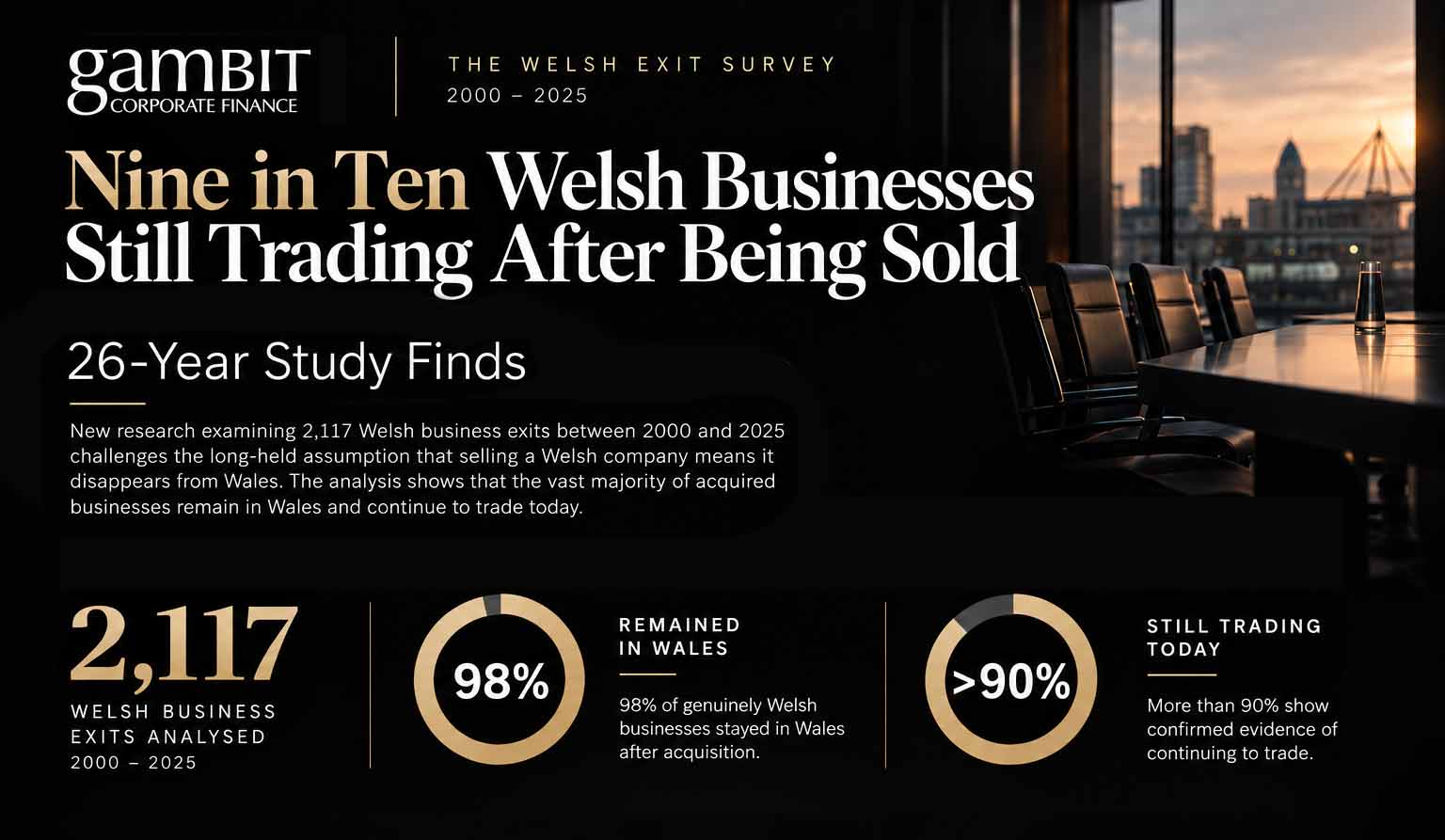
Of 2,117 exits examined, the firm says over 90% of genuinely Welsh businesses remained in Wales after acquisition, showing confirmed evidence of continuing to trade today.
That potentially changes the succession debate.
For an ageing generation of Welsh entrepreneurs, the question may increasingly be less about whether their businesses should change ownership and more about which ownership structure gives those companies the best opportunity to survive, invest and grow for another generation.