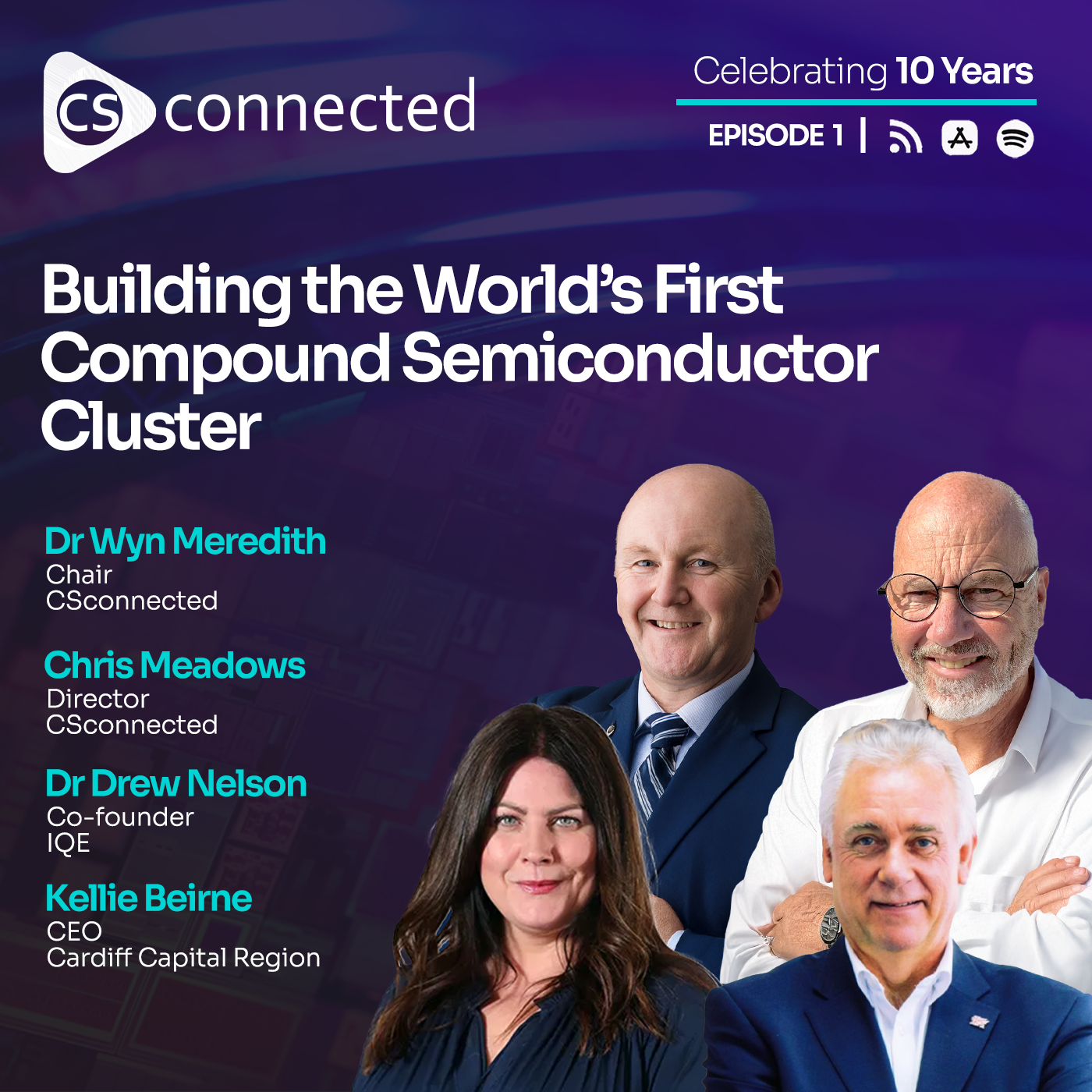


When the UK Government published the 10-year modern industrial strategy last November, they called it ‘unashamedly long-term’.
A plan, they said, that would make the UK the best place to invest, build, and grow a business anywhere in the world. The plan identified eight growth sectors seen as most well-positioned to create the wealth, jobs, and higher wages needed in communities across the country. These sectors, seen as critical to national prosperity, economic security, resilience, net zero, and regional growth, were to be supported with the creation of the favourable conditions needed for businesses within them to emerge and scale, leaning into supporting already-established places and clusters across the UK.
The foundational advanced technology supporting the industrial strategy
While each priority sector (the IS-8) has distinct challenges, five of the eight share a common foundation. They depend on semiconductors. From Advanced Manufacturing to Life Sciences, from Defence to Digital and Technologies, which includes AI to Quantum, the UK’s ability to succeed in these sectors is inseparable from the semiconductor components that drive them. Quite simply, they are not just a strand, as positioned in the strategy itself; they are the frontier technology that will make the ambitions of the strategy possible.
A Paper on Unlocking UK Economic Growth, published by The APPG for Semiconductors earlier in February, sets this out. Strengthening the UK's semiconductor ecosystem delivers a multiplier effect across the Industrial Strategy as a whole. Every sector plan depends on it. Every growth goal rests on it. Recognising and supporting this cross-cutting role is essential to the strategy delivering what it promises.
Not all semiconductors are equal. The silicon chips that power everyday computing are vital, but they are not where the UK's competitive advantage lies, nor where the most strategically critical applications demand something more. Compound semiconductors, made from combinations of elements such as gallium nitride, silicon carbide, gallium arsenide, and indium phosphide perform in conditions and at speeds that silicon cannot match. Silicon carbide is the material enabling the power electronics driving the electrification of transport and energy infrastructure. Gallium nitride is the compound at the heart of high-frequency defence systems, radar, and electronic warfare.
Competing in a trillion-dollar global race
The global semiconductor market is expected to be worth $1 trillion a year by 2030, driven by an explosive demand for AI infrastructure, electric vehicles, clean energy systems, and advanced defence capability. Despite being poorly understood, it is the technology market that almost every other technology relies on.
Yet few nations have the infrastructure, skills, or depth of ecosystem to compete effectively on the world stage. The UK is one of these, alongside the US, the EU, China, Taiwan, Japan, and Korea. But while these global superpowers move at pace to scale, committing the major funds of US $52 billion, EU €43 billion, Taiwan $10 billion, the UK has committed modest funding of £1 billion to date as part of its UK Semiconductor Strategy allocation.
With constrained public funding, the UK must concentrate investment where it already has a genuine, proven global advantage, doubling down on comparative strength to build the sovereign capability the Industrial Strategy demands.
Introducing the world’s first compound semiconductor cluster
The perfect opportunity to do this already exists. And it is built, operating, and growing here in Britain. South Wales is home to a compound semiconductor cluster, offering the only fully integrated semiconductor supply chain in the UK, and even the world.
It has cluster anchor companies including global players such as IQE, the world's largest manufacturer of compound semiconductor epiwafers, the foundational material from which compound semiconductor devices are made, and KLA, one of the world's leading semiconductor process control companies which operates an R&D and manufacturing centre in Newport. These operate alongside Vishay, whose facility is the largest compound semiconductor manufacturing site in the UK, to which they have recently committed £250 million. Add to that Microchip Technology and the Compound Semiconductor Applications Catapult, responsible for mobilising the UK Semiconductor Centre under the Semiconductor Strategy, with lab facilities and research across Cardiff and Swansea universities available to the cluster.
The Industrial Strategy itself acknowledges the value of cluster co-location, and South Wales answers this call directly, offering a density of universities, R&D infrastructure, anchor businesses, supply chains and specialist skills. They are all established and already scaling, ready to accelerate production of the frontier technology of the Industrial Strategy.
Leaning into ten years of investment in specialist infrastructure
Semiconductor research and manufacturing infrastructure is particularly difficult to replicate. Highly specialised, large-scale ultra-clean and environmentally stable facilities are required to house high-value capital chip fabrication tools. The specialist cleanroom and fab infrastructure at the Centre for Integrated Semiconductor Materials at Swansea University and the Institute for Compound Semiconductors at Cardiff University represent a £200 million investment in new-build facilities and equipment. The highly specialised laboratories at the Compound Semiconductor Applications Catapult in Newport contain cutting-edge chip test, characterisation and module assembly equipment. Collectively, these facilities offer semiconductor companies locating to South Wales open access to unique capabilities they would otherwise have to fund entirely by themselves. That shared infrastructure model is a significant competitive advantage for the cluster and is accelerating the growth of a high-tech SME ecosystem around the large-scale industrial core.
Powered by a generation of talent
South Wales has a generation of compound semiconductor engineers, technicians, process specialists, and researchers who trained, who work, and who have established lifestyles within the region. This not only means rewarding, well-paid careers for them in the area they call home, but it also means that the highly specialist skills required for compound semiconductor manufacturing are readily available in the region. This is bolstered further by the cluster's skills pipeline, which extends from vocational and apprenticeship routes through to postgraduate research.
CSconnected, the not-for-profit body that convenes the South Wales compound semiconductor cluster, is actively closing the skills gap further with a skills development programme to deepen and broaden that pipeline, collaborating with Cardiff and Swansea universities to provide continuous specialist talent into cluster companies. The region's ability to recruit and retain this talent locally is one of the primary reasons global companies continue to choose South Wales over competing locations in Germany, the Netherlands, and the United States.
A supply chain that is being built, not borrowed
Perhaps the most telling indicator of a cluster that has reached genuine maturity is what happens around its edges in the network of suppliers, service providers, and specialist businesses that grow up to support its anchor companies. A cluster that depends entirely on imported components and overseas suppliers is an outpost. A cluster that generates its own supply chain is a self-sustaining industrial ecosystem.
South Wales is actively building the latter. CSconnected's Supply Chain Development Programme, backed by £1 million in funding from Cardiff Capital Region and launched in March 2025, is systematically mapping the procurement needs of the cluster's major companies, identifying where domestic suppliers can meet those needs, and funding the capability upgrades required to close the gaps. In less than a year, the programme has engaged more than 40 suppliers and has five active development projects running simultaneously.
Philtronics, a South Wales electronics manufacturer, has developed new capabilities that have allowed it to become a direct supplier to KLA, keeping procurement spend within the regional economy that would previously have gone overseas. Pegasus Chemicals has undergone a capability upgrade that positions it to serve the cluster's specialist materials requirements.
A return on investment which is already measurable
The cluster generates £150,061 of GVA per employee, which compares incredibly favourably against typical UK manufacturing, which sits at around £55,000–£65,000. The compound semiconductor cluster is running at roughly two and a half times the national manufacturing average, a productivity premium that, if replicated at scale, would represent one of the most significant contributions any single UK industrial cluster could make to the UK Government's growth mission.
This is not a sector asking to be subsidised into competitiveness. It is a sector already operating at world-class productivity levels, asking for the investment needed to grow.
A ten-year track record of impact
- £850 million invested in facilities.
- £150 million invested in collaborative R&D
- GVA growth of almost 50% (48%) since 2020
- £434 million in UK GVA in 2024
- £466 million of goods exported to global markets
- 95% of cluster production sold internationally.
- South Wales is not consuming national resource. It is generating foreign earnings for the British economy.
Public investment here has a proven return
When the Semiconductor Infrastructure and Partnership Fund and Cardiff Capital Region backed the development of cluster infrastructure in 2020, global companies took notice. Since then, Vishay has committed £250 million to its Newport facility. KLA has invested £138 million in an R&D and manufacturing centre. These are not companies that were lured here by subsidies. They are companies that assessed the cluster's capability, concluded it offered something their other global options could not, and made long-term capital commitments accordingly
This is the definition of investment, not subsidy, a distinction that should carry considerable weight at a time when government is rightly focused on the quality and return of its industrial spending. Every pound of public co-investment into this cluster has returned multiple pounds of private capital, alongside the jobs, exports, and supply chain activity that capital creates and sustains.
The CSconnected compound semiconductor cluster provides a gateway for the UK to build the world-leading sovereign capability that underpins its clean energy transition, its defence resilience, its AI infrastructure, and its advanced manufacturing base. Where a genuine global niche already exists, this is an opportunity to help the region prosper, creating value for its own community, and for the wider UK economy. But government investment decisions must be made quickly, with the urgency the global semiconductor race demands, to reap the benefits of this already thriving cluster, securing the global market share it's capable of, and moving towards achieving the ambitions of the Industrial Strategy.