





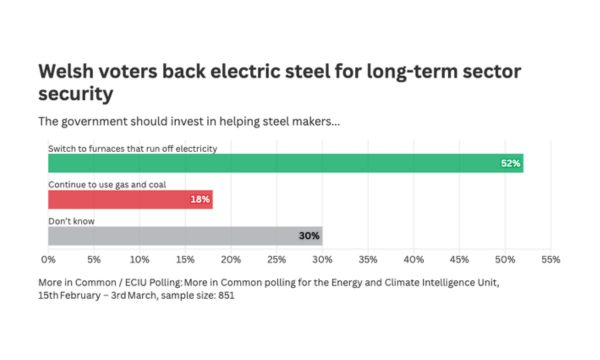
Welsh voters are more than twice as likely to believe that the Welsh steel industry will be more secure in the long-term if it electrifies its operations than if it continues relying on conventional gas and coal power, new polling suggests.
More than half (52%) of voters said that the steel sector in Wales would be more secure in the long-term if the government invested in helping steelmaking sites switch to furnaces that run off electricity compared to fewer than one in five (18%) who said the industry would be better off if the government supported sites in continuing to run on gas and coking coal.
The results of the polling, which was conducted by More in Common on behalf of the Energy and Climate Intelligence Unit (ECIU), were announced as the Business Secretary, Peter Kyle MP, prepared to launch the UK Steel Strategy in Port Talbot.
Senior Associate at the ECIU, Laura Dunn, said:
“It’s clear to the Welsh public that dependence on gas has left its industrial base badly exposed to global volatility in international energy markets, with profound implications for our economic and national security. As the world moves increasingly towards electrifying steel production voters see this as the future for Wales and a way to safeguard jobs. Net zero technologies like renewables, electric cars and clean steel are growing market share around the world and enabling countries to be more energy independent, less reliant on oil and gas imports”.
The UK Steel Strategy is expected to set out a long-term plan for the UK steel sector, which has been hit hard by rising energy prices in recent years with the trade body UK Steel stating the “main driver” of this is “the UK’s reliance on natural gas power generation” . With gas prices climbing to their highest levels since 2022 due to conflict in the Middle East, there are widespread concerns about the effects on Welsh industry of a new energy price crisis.
In the polling the most common causes of steel job losses in Port Talbot and Newport were believed to be competition from China and India (42%), overseas-owned businesses failing to prioritise Welsh jobs (36%) and a lack of support from the UK Government (35%). Just one in five voters (20%) attributed the closures to net zero and climate policies and targets – the second least selected option, after actions by trade unions (9%).