GUEST COLUMN:
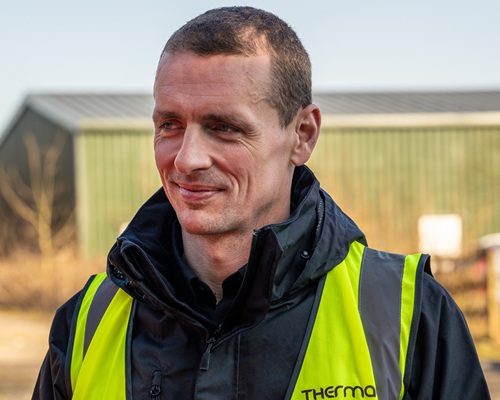
Nick Salini
Director
Thermal Earth

We started Thermal Earth in 2006 with a clear belief: fossil fuels were not the future for heating our homes and buildings. Nearly 20 years on, that belief has only strengthened.
Over the years, we’ve delivered ground and air source heat pump systems for everything from small domestic homes to schools, hospitals and large commercial schemes. But now, for the first time, we’re demonstrating what’s possible when we look beneath our feet – literally.
At our base in Ammanford, we’ve just completed a project which we hope will change the conversation around low-carbon heat. By working with the Mining Remediation Authority and support from Innovate UK, we’ve been able to harness the latent heat from mine water at the nearby Lindsay mine water treatment site. It’s a local source of energy that had never been tapped before.
The system itself is relatively simple in concept but powerful in its potential. We installed a heat exchanger in a settlement lagoon at the treatment site. This picks up low-grade heat from the mine water, which flows year-round at around 15 degrees Celsius. The heat pump at our facility then compresses that energy to usable temperatures, providing heating and hot water to our building. That’s it – clean, renewable heat from a resource that was previously going to waste.
At the moment, we’re the only building connected to it. But the point is not what we’ve achieved for ourselves – it’s what this could mean for others. This is a demonstrator. A proof of concept. And its implications are significant.
There are dozens of mine water treatment schemes across the UK. All of them deal with flows of warm water, many operating 365 days a year. Until now, that heat has largely gone unclaimed. But it doesn’t have to be that way. The project we’ve completed in Ammanford shows what’s possible with a bit of vision and the right technical expertise.
This isn’t the only untapped opportunity. There are industrial sites across Wales and the UK pumping warm water to waste, sometimes at 20 degrees or more. That energy could be recovered and repurposed with the right systems in place. These are what we call low-temperature, high-volume heat sources. They’re not headline grabbing, but they are technically viable and incredibly efficient when done right.
Too often, these systems don’t get taken forward. Why? Because they’re seen as risky, or because they don’t deliver immediate returns. But when we only plan for the short term, we limit what’s possible. We need a change in mindset, not just among developers, but right across the board.
We need more ambition, from top to bottom. From government and local authorities to housing associations, businesses and homeowners. Everyone has a role to play. But the first step is understanding what’s possible and that’s why we built this demonstrator. We want others to see it, visit it, learn from it and then replicate it.
It’s not just about carbon savings, although those are significant. It’s about resilience. It’s about security. It’s about investing in systems that not only reduce emissions but protect your business against future volatility. And yes, it’s about value too, because over the long term these systems can deliver serious savings.
Heat pumps, when integrated with technologies like solar PV and battery storage, open up new ways of managing energy on-site. That means storing electricity when it’s cheap, using it when it’s needed, and minimising demand from the grid. In the future, these systems won’t just heat buildings – they’ll be smart, responsive, and integrated into wider energy infrastructure.
We’re already in conversations with developers, housing associations and other organisations about how this can be applied more widely.
This is an exciting time for our industry but it’s also a critical one. Decisions made today will shape our energy future for decades. That’s why we need to stop treating climate risk as a compliance exercise and start seeing it for what it is: a driver of innovation, a source of opportunity and a reason to think differently.
Nick Salini talks about this and more in the BIC Innovation podcast episode From Mine Water to Market Opportunity – Climate Innovation. Listen to the podcast here.