A new report examines how the climate, geopolitical conflicts, commodity markets, logistics disruption and economic pressures combined during the first half of 2026 to create significant challenges for food supply chains.
Introduced at the Royal Welsh Show and produced as part of the Welsh Government-funded Food & Drink Wales Climate Resilience Service, the report provided the focus for an event that brought together food and drink industry stakeholders to explore its findings, raise awareness of the issues affecting the sector, and consider the implications for businesses across the whole supply chain.
The Food and Drink Climate and Supply Chain Risks Quarterly Monitor report highlights that Welsh manufacturers are increasingly exposed to events occurring far beyond the UK’s borders. During the first six months of this year, severe flooding in Spain and Morocco disrupted fresh produce supplies, while drought has affected major cereal-producing regions in North America. At the same time, conflict in the Middle East disrupted shipping through the Strait of Hormuz, driving significant increases in energy and fertiliser prices.
The report also points to the record-breaking UK heatwaves in May and June and the ongoing heat experienced in July, which has placed additional pressure on agricultural production, cold-chain infrastructure and workforce productivity. Combined with the emergence of a potentially very strong El Niño event, expected to intensify later this year, these developments could contribute to increased volatility across global markets for commodities including coffee, cocoa, sugar, rice and vegetable oils.
Linda Grant, Food & Drink Wales Climate Resilience Service lead, said:
“Climate change is no longer a future risk—it is already influencing the cost, availability and reliability of food ingredients, packaging, energy and transport. Welsh manufacturers are operating within highly interconnected global supply chains, meaning events thousands of miles away can quickly affect production costs here in Wales.”
The report highlights a range of factors influencing food supply chains, including extreme weather, rising commodity prices, export restrictions and transport disruption. It also explores the UK’s reliance on imported food and agricultural inputs from regions increasingly vulnerable to climate change.
Abi Reader, NFU Cymru President, shared insights at the event from her role as both a dairy farmer and a representative of the farming sector. She said:
“My farm has experienced drought conditions over seven of the last eight years. The extreme heat places burdens on livestock and farmers alike and is something that we must adapt to. Farmers are innovative and are finding adaptations, from technology to nature-based solutions. For example, I have been delighted to work with Coed Cymru and the South East Wales Rivers Trust to plant more trees to provide shade for our cows. Working together with stakeholders, our industry is adapting and playing our part in ensuring Wales continues to produce high quality food.”
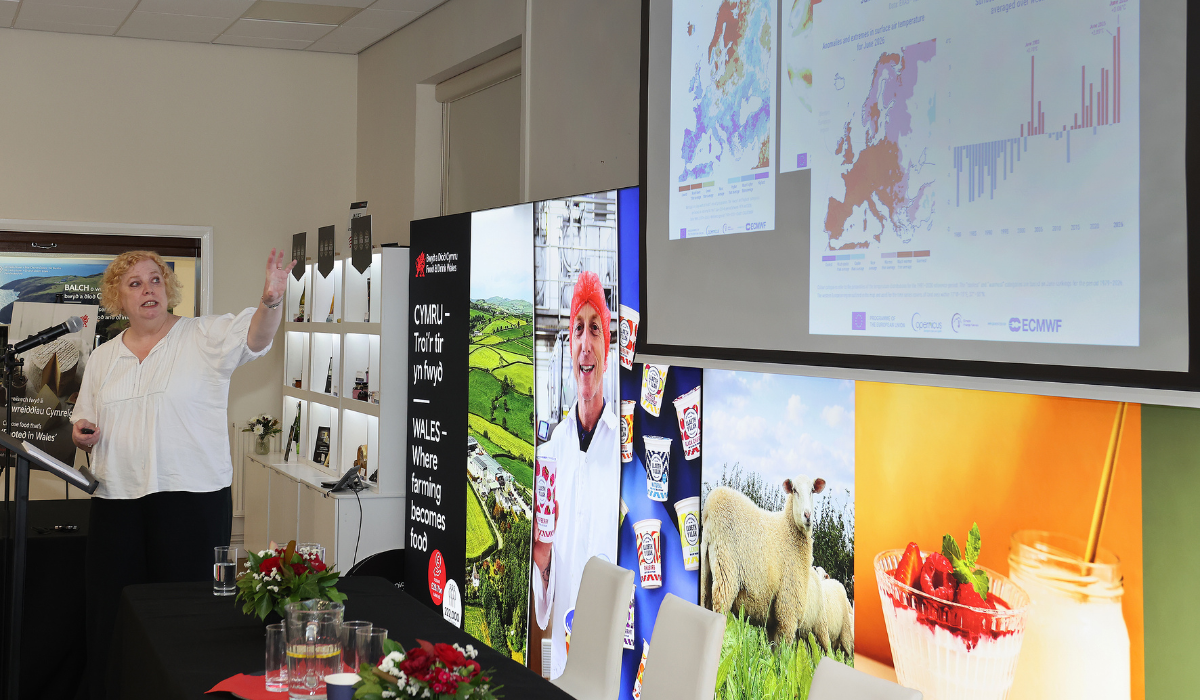
Alongside analysing global developments, the report provides practical guidance for Welsh food and drink manufacturers, encouraging businesses to review contingency plans, strengthen supplier relationships and incorporate climate-related risks into strategic decision-making. Support to help businesses take action in these areas is available through the Welsh Government’s Climate Resilience Service.
Castell Howell has seen the value of this support firsthand and Edward Morgan, Group CSR Manager, highlighted how working with the service has helped to shape their future supply chain strategy. He said:
“We benefited from some detailed research looking at key points of our supply chain, here in the UK and overseas. We are seeing pressures from more climate vulnerable countries such as Spain and Morocco as well as some of our UK suppliers who have struggled in the recent heatwaves or are vulnerable to other climate risks. I would urge any food or drink manufacturer to engage with the Climate Resilience Service, which offers bespoke leadership team workshops to help guide businesses through the risks and opportunities that climate change is already bringing. It is vital for us to be a resilient supplier to our customers and, in turn, for our own suppliers to be resilient in the face of climate change.”
The Food and Drink Climate and Supply Chain Risks Quarterly Monitor will be published every quarter, providing businesses with timely intelligence to support procurement, forecasting and business resilience.
The Climate Resilience Service forms part of the Welsh Government’s wider programme of support for the food and drink industry. The Service, delivered by BIC Innovation, helps food and drink businesses understand how climate change could affect their operations and develop practical strategies to adapt and thrive in an increasingly uncertain world.