
GUEST COLUMN:
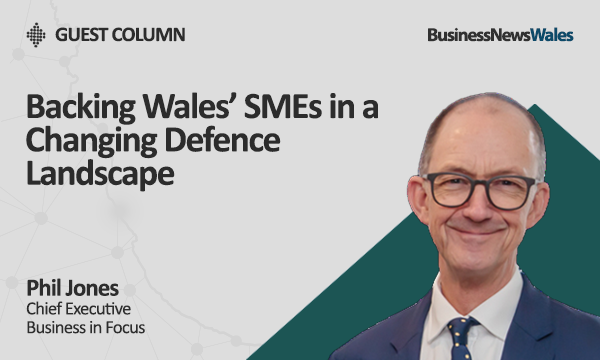
Phil Jones
Chief Executive
Business in Focus
Geopolitical, economic and societal uncertainty is not something businesses experience at a distance. It affects planning, investment and day-to-day operations. Whether you lead a one-person business or employ 180 people, there is a direct line between what is happening globally, nationally and in a devolved context, and the success of your business plan in 2026.
As business leaders we need to be alert not just to what is happening within our immediate sphere of influence, but to the wider forces shaping the environment around us. That does not mean becoming distracted or alarmist. It means understanding that global events can create both opportunities and threats and being prepared for both. I come from a military background, where threat is understood as a combination of capability and intent. The same is true of opportunity. If you understand those two elements, you are far better placed to respond effectively.
We are operating in a world that appears to be shifting away from a broadly rules-based approach towards one defined more by spheres of influence. Businesses and countries alike are making choices about where they sit and who they trade with. For businesses in Wales, this reinforces the importance of building the capability needed either to thrive within those spheres or to adapt as they evolve.
Resilience is often discussed as a single quality, but I think it is more helpful to view it through three lenses. The first is conceptual resilience. Are we intellectually prepared for the ebbs and flows of business and for the realities of the world we are operating in? The second is moral resilience. Are we, and our teams, in a position to cope with pressure, uncertainty and opportunity? The third is physical resilience. Do we have the resources, systems and digital readiness to adapt at speed when required?
Taken together, these three elements form the basis of business vitality. Focusing on just one, while neglecting the others, leaves businesses more exposed, particularly during periods of sustained uncertainty.
Over recent years there has been a steady queue of political, fiscal and economic events, each promising clarity once it has passed. But there is a danger in waiting for the next event to deliver certainty before acting. While businesses value certainty, over-reliance on it can become a brake on growth.
That said, businesses involved in public sector supply chains, for instance, do need to plan for potential delays during election periods, such as the upcoming Senedd election in May. This is a practical reality rather than a political observation. Understanding where delays might occur, and building that into cash flow and delivery planning, is part of managing risk. At the same time, businesses have an opportunity to engage constructively with those seeking office, helping them understand how uncertainty affects investment decisions, confidence and growth.
It is also important to remember that opportunities exist alongside these challenges. Through the Business Wales service, which Business in Focus helps to deliver, businesses across Wales are being connected with significant routes to market. There is substantial potential within supply chains, but accessing it requires preparation, investment and readiness. Resilience, in this context, is about staying match-fit rather than standing still.
Support plays a critical role. None of us is alone. Peer networks offer valuable perspective, reassurance and shared learning, particularly when confidence is under strain. Beyond that, Business Wales provides access to advice and guidance for businesses at every stage, from kitchen-table start-ups to established firms with significant turnover. The people delivering that support understand business and are there either to help directly or to connect firms into wider networks.
Looking ahead, I would offer three practical thoughts for business leaders navigating the current climate. First, continue to invest in your people, however difficult that feels. Skills, capability and commitment remain central to long-term success. Second, take time to think carefully about how your business will grow. That may mean deepening existing markets, diversifying products or reaching new customers in order to mitigate risk. Third, seek partnerships. Collaboration builds capability, and it is through partnerships that businesses can better address both threats and opportunities.
Resilience is not about enduring uncertainty indefinitely. It is about understanding it, preparing for it and positioning your business to move forward despite it. With the right mindset, strong networks and access to support, businesses in Wales can use the year ahead not just to cope, but to put themselves in a stronger position for what comes next.
Phil Jones talks about this and more in the Business in Focus From Startup to Scaleup podcast. Listen here.