
Public and private sector leaders across Cardiff Capital Region (CCR) say collaboration on innovation projects demonstrates how cross-sector working could reshape the way major public service challenges are tackled.
Those involved in a medical technology challenge describe the approach as offering “revolutionary” potential in how new solutions are developed and tested, with the combination of clinical insight, public sector problem-setting and industry expertise accelerating progress in ways that would be difficult to achieve in isolation.
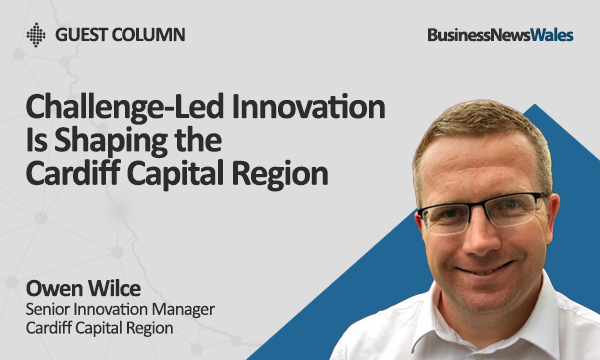
Speaking on the Cardiff Capital Region podcast, Senior Innovation Manager at CCR, Owen Wilce, said challenge-led work had demonstrated how well-defined public sector problems can encourage businesses and researchers to step forward with ideas that directly respond to real life pressures.
His team’s role, he said, centres on identifying issues facing communities and public services, then creating the conditions for solutions to be explored in practical, real-world testbeds. Owen noted that modest public investment, coupled with clear problem definition, can help move development forward at a pace not often seen through conventional routes.
He also pointed to the value of partnerships that bring together clinical teams, procurement specialists, academic analysis and innovation expertise.
In the case of a project involving Cardiff and Vale University Health Board and Monmouthshire-based company IQ Endoscopes, he said the collaboration gave the company access to those who understand where pressures lie, while offering the public sector a structured way to shape and test emerging tech alongside day-to-day operational realities.
General Surgical Registrar Jennifer Waterman of University Hospital of Wales said the experience had highlighted the potential of partnership working to support new approaches in areas under strain. She said the team had recognised a need to look differently at how some patients move through endoscopy pathways, and that the collaboration with industry had enabled them to examine which groups might be safely seen in alternative clinic-based settings.
This could free capacity within the endoscopy department while also offering more training opportunities for resident doctors and nurse endoscopists. Although still in development, Jennifer said the work showed how new models of care could take shape when clinicians and industry work side by side from the outset.
Jennifer also emphasised the breadth of the collaboration, describing it as unusually wide-ranging.
“I've never personally been involved in a project with such an amazing team,” she said.
“To have innovation, procurement, operations, sustainability, industry, funders coming all together to try and collaborate to find the right product for the right demand – it really has been a unique journey.”
For IQ Endoscopes, the process has influenced the company’s approach to development, particularly around understanding how their sustainable, single-use device needs to perform within NHS pathways. CEO Matt Ginn said insight from clinicians, procurement leads and sustainability specialists shifted the company’s focus, especially in relation to the environmental impact of the full patient journey. He added that independent assessments carried out by Cardiff and Vale Health Board had strengthened the company’s evidence base when speaking with funders.
Matt also noted that the collaboration had supported the company’s growth in Wales, with IQ Endoscopes expanding its workforce in Monmouthshire as development continued.
The work has also offered learning for public bodies themselves, particularly around procurement. Owen said the Cardiff and Vale procurement team had shown how early involvement can support the adoption of new technologies, rather than becoming a barrier later in the process. He described the relationships formed across the project as central to the progress achieved.
Looking ahead, Owen highlighted Cardiff Capital Region’s success in securing the Local Innovation Partnership Fund with UK Research and Innovation. He said the upcoming programme, worth at least £30 million to the region, will provide further support for research, development and commercialisation. The investment builds on the credibility developed through earlier innovation activity and offers a significant opportunity to continue shaping solutions with practical impact, he said.
Hear more in the Cardiff Capital Region podcast episode Endoscopy Challenge: Idea, Innovation and Impact. Listen here.