GUEST COLUMN:
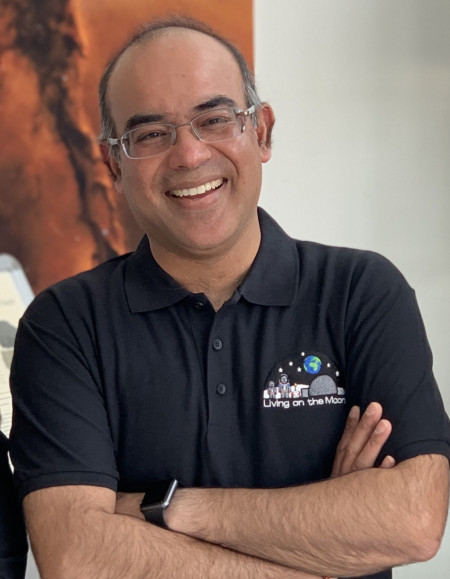
Professor Mahesh Anand
Director of Research
School of Physical Sciences, The Open University

When people think about space, they often imagine rockets, astronauts and distant worlds. But the true story of space begins much closer to home – in classrooms, communities and conversations that spark curiosity in young minds.
As a lunar scientist, I have spent my career studying Moon rocks and soil brought back by the Apollo astronauts, helping to understand how we might return to the lunar surface in a sustainable way. That work connects me with colleagues across the world, from NASA in the United States to the European Space Agency and the Chinese lunar programme. Yet the most important part of my work may still be here on Earth: inspiring the next generation to see science and engineering as something within their reach.
The decision to pursue science often happens long before a student ever applies to university. Studies show that by the age of ten, many children have already decided – consciously or not – whether they see themselves as “science people”. If we want to build the skills Wales will need for the industries of the future, we must reach them earlier than we think.
That is why I am so passionate about public engagement. Visiting schools, talking to pupils, and showing them the real-world impact of scientific research can change lives. The space sector is uniquely powerful in that respect. It fires the imagination, but it also offers practical lessons about teamwork, innovation and sustainability. By linking the excitement of exploration to the tangible opportunities here in Wales – in energy, technology and advanced manufacturing – we can show young people that their future does not have to be elsewhere.
Wales already has the ingredients to build a strong space ecosystem. It has a vibrant network of small and medium-sized enterprises, a growing cluster of research activity, and a commitment from government to invest in innovation. What it also has is a heritage of engineering and craftsmanship that lends itself perfectly to the challenges of space technology. The same ingenuity that once powered the industrial revolution can now power the next wave of scientific discovery.
For that to happen, the link between academia and business must be closer than ever. Universities have a responsibility to understand what industry needs today and what it will need in ten years’ time. In turn, businesses can help shape the research, training and apprenticeships that prepare people for those roles. At the Open University, we work with further education colleges as well as universities to widen participation and ensure that people from every background can gain the skills to work in these emerging sectors.
Projects such as the proposed Earth and Space Innovation Hub at Aberthaw will depend on this kind of joined-up approach. If realised, it could draw from the local workforce, create new technical jobs and help build a self-supporting network of skills across south Wales. That model – developing talent from the ground up rather than importing it from elsewhere – could prove transformative for regional growth.
Space, by its very nature, encourages collaboration. It transcends boundaries of geography and politics. No one nation owns the Moon, and no single organisation can explore it alone. I have been fortunate to work internationally throughout my career, analysing samples brought back by missions from the United States to China. What unites all of those efforts is a belief that knowledge is shared, not hoarded. That same principle should guide how we develop the space sector in Wales.
If we can connect the dots between research and industry, education and opportunity, local effort and global collaboration, then Wales can play a far greater role than its size might suggest. I like to think of it as “small but mighty” – a nation capable of punching above its weight through innovation, agility and community spirit.
In the years ahead, I hope to see Wales recognised not only for its scientific contribution but also for the way it engages its people. Space truly is for all. From primary schools to policymakers, everyone has a part to play in shaping what comes next. If we can inspire our children to dream big and then give them the tools to turn those dreams into reality we will not only advance science but strengthen society.
And perhaps, one day, a young person from a Welsh classroom will look up at the Moon and think: I helped make that mission possible.
Professor Mahesh Anand talks about this and more in the Cardiff Capital Region podcast episode Space Innovation: South East Wales at the Frontier. Listen to the podcast here.