GUEST COLUMN:
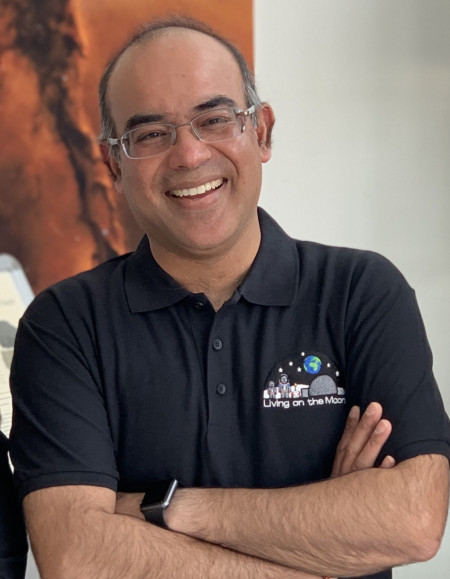
Professor Mahesh Anand
Director of Research
School of Physical Sciences, The Open University

When I first visited the former Aberthaw power station site, I was struck by how much it resembled the lunar surface. The fine grey dust felt eerily familiar to the lunar soil I have spent my career studying.
For decades, Aberthaw was known for powering the nation. It generated electricity for much of the UK and it was producing thousands of tonnes of pulverised fuel ash, or PFA, as a by-product of coal combustion. Today, that same ash – millions of tonnes of it, mountains of it – is still at the site. Once seen as waste, it may now hold the key to one of Wales’ most exciting scientific opportunities.
As a lunar scientist, I have worked with Moon rocks and soil samples brought back by the Apollo astronauts. My research is driven by a single question: how can we return to the Moon in a sustainable way?
Space exploration has entered a new era, one where reusing and recycling resources is essential. Everything we take to the Moon must serve a purpose, and everything we find there must be used wisely. In space, there is no such thing as waste.
Here on Earth, however, we have been less disciplined. Over generations we have created vast landscapes of industrial by-products, left behind by the industries that once powered our economy. Yet those so-called waste materials often contain valuable elements – minerals and metals that could be repurposed using the same techniques we are developing for lunar resource extraction.
A few years ago, I began working in north Wales, studying mine waste left over from the copper industry that flourished there two centuries ago. The technology of the time meant that much of the valuable material was never recovered. Today, we have the tools to change that. Modern extraction technologies could recover metals from those old deposits at concentrations far greater than we currently mine elsewhere in the world. That discovery started me thinking: why not use the lessons we are learning in space to transform how we manage resources here on Earth?
That question led me to Aberthaw. When I saw the PFA mountain, I recognised immediately its potential as a lunar analogue – a material that could mimic the properties of Moon dust. It looks, feels and behaves remarkably similarly. This opens up the possibility of creating a controlled lunar-like environment right here in Wales, where we can test and develop technologies designed for use in space.
The UK currently lacks a dedicated centre for this kind of work. An Earth and Space Innovation Hub at Aberthaw could change that. The idea is to use PFA not only to replicate lunar conditions for research, but also to explore what useful materials might be recovered from it – just as we would on the Moon or an asteroid. In doing so, we could advance both space science and sustainable industry at the same time.
The potential impact is huge. Imagine being able to test lunar machinery and robotics in conditions almost identical to those they will face on the Moon, while also using that same process to recover valuable elements for use on Earth. The benefits would reach far beyond the scientific community, supporting new industries, creating skilled jobs and breathing new life into a site once associated with fossil fuels.
But for this vision to succeed, collaboration is essential. Space science does not exist in isolation; it thrives when academia, business and policymakers work together. At the Open University, we are working closely with CCR Energy, and with partners in government and industry. If Aberthaw becomes what I believe it can be – a true poster child for space innovation – it will be because Wales has embraced that spirit of collaboration.
Space, by its very nature, crosses boundaries. It brings nations, institutions and generations together in pursuit of knowledge. Wales has a long tradition of discovery and industry; now it has a chance to apply that tradition to a new frontier. From the mines of North Wales to the ash fields of Aberthaw, the story is the same – what we once discarded as waste could become the foundation of something extraordinary.
Professor Mahesh Anand talks about this and more in the Cardiff Capital Region podcast episode Space Innovation: South East Wales at the Frontier. Listen to the podcast here.