




A Cardiff University research project is among dozens which are being backed to grow into market-leading products and services by UK Research and Innovation (UKRI).
A new £9 million proof of concept programme spans – amongst other fields – medicine, space science, the environment and artificial intelligence (AI) and will help to harness the potential of world-leading UK research to improve lives.
The 48 projects receiving funding aim to support and accelerate the development of new or improved technologies, products, processes and services arising from research to drive growth and create the new jobs of tomorrow.
Projects include:
- EndoTect: a new urine test for endometriosis
A rapid and sensitive test, capable of diagnosing people with endometriosis as having deep or superficial disease at the point of care – without the need for hospital visits, specialist involvement, or long wait times - STARLITE: Super-miniature ultra-sensitive force sensors for small innovative spacecraft, next-gen aircraft and cutting-edge biotech applications
This innovation will transform measurement standards in several sectors, with STARLITE focusing on applications in aviation, while simultaneously establishing a platform for exploitation in the space and biomedical sectors - CamBoom: Championing inclusion in cricket with engineered bamboo bats
With over 200 million people playing cricket regularly – the majority in low-and-middle-income countries – there is a strong consumer demand for low-cost recreational cricket bats - AI Mapper+: Vision-Language models (VLMs)-powered accessible journey planner for disabled people
AI Mapper is a novel generative AI-powered accessible journey planning technology that leverages a wealth of real-time data from public transport authorities for many individuals including people with disability (e.g., people with visual impairment) to complete the journey comfortably and safely
Science Minister Lord Vallance said:
“UK universities are renowned for world-class research, but we must do more to encourage and support the experts behind it to bring their discoveries to market – building companies, driving growth and helping to improve people’s lives.
“From simpler ways of diagnosing illnesses to AI tools plotting accessible routes, we are giving promising projects the early support that can help them get off the ground, benefitting us all and growing our economy.”
Professor Charlotte Deane, UKRI’s Research Commercialisation Executive Champion, said:
“These projects are a powerful demonstration of the UK’s talent for turning cutting-edge research into real-world solutions. From health and sustainability to quantum and creative technologies, they reflect the extraordinary breadth of innovation being nurtured across the UK’s research base. UKRI’s new proof of concept programme is all about helping researchers take that critical next step toward commercialisation, ensuring that bold ideas are not just published but put into practice where they can deliver tangible impact. I’m excited to see how these diverse and dynamic projects progress.”
Dr Ananay Aguilar, Director of TenU, said:
“Today’s announcement of Proof-of-Concept (PoC) funding for academics who want to turn innovation into companies is a glimpse into the future. Here we have the next generation of high-potential university spinouts – we may have the next Oxford Nanopore on our hands.
“Innovators tell us time and again that one of the biggest challenges they face is making the leap from academia to starting a company and this announcement puts the spotlight on the vital importance of PoC funding.
“That is why TenU, with its members and partners, is exploring ways to optimise the impact of current and future PoC funding. Our expert working group – including funders, investors and industry – is looking how we can enhance fund sustainability and bring investors and industry closer to the PoC process.”
The proof of concept initiative from UKRI – the UK’s major public funder of research and innovation – follows an independent review of university spin-outs, published in November 2023.
A focus for many of the projects is to support and innovation in public services, including in NHS trusts. Other projects will help small and medium enterprises become efficient as they grow and scale.
Working across all disciplines, this funding provides critical early-stage support to projects. It helps researchers and innovators bridge the gap before attracting private investment, reducing the risks associated with premature market entry.
Designed to enhance the readiness of new products and services developed through research, the initiative helps set the stage for successful commercial launches.
It fosters innovations that have the potential to significantly improve societal wellbeing and economic outcomes, supporting the translation of groundbreaking research into solutions that enhance lives and communities.
The 48 projects receiving funding are as follows:
|
Exact PEGylation for Protein Therapeutics – ExactPEG |
Queen Mary University of London |
|
The Digital Endometrium Function Test |
University of Warwick |
|
In vivo proof of concept evaluation of virotherapies targeting glioblastoma |
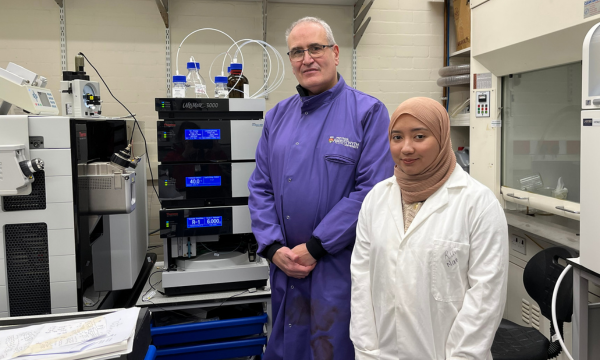
Cardiff University |
|
The TEEP Valve: A clinician-designed, low-cost device to maintain airway pressure and prevent aerosol spread in critically-ill patients |
Imperial College Healthcare NHS Trust |
|
EndoTect: Validating a urine test for endometriosis |
University of Hull |
|
Development of a maternal vaccine to prevent neonatal sepsis |
Queen's University Belfast |
|
MED-SHED: Machine-learning-based EEG Decision support; pioneering Social enterprise for HEalth Data |
University of the West of England |
|
Arclight Dermatoscope: rapid, cost-effective skin cancer triage |
University of St Andrews |
|
Commercialising a Scalable Training Programme for Rehabilitation Professionals |
Bournemouth University |
|
STARLITE: Super-miniature ultra-sensitive force sensors for small innovative spacecraft, next-gen aircraft and cutting-edge biotech applications |
Queen's University Belfast |
|
Advanced Detection of Opioids and Emerging Illicit Drugs |
University of Liverpool |
|
Accelerating the Spinout of OPAU: A Waterless Technology Platform for Sustainable Health and Personal Care Product |
University of East Anglia |
|
Cyberhare's IntegraGuard – Fortifying Excellence with Advanced Integrity Management, Detection and Deterrents. |
University of the West of Scotland |
|
CamBoom: Championing inclusion in cricket with engineered bamboo bats |
University of Cambridge |
|
Transmedia Storytelling for Immersive Brand Experiences |
University of the Arts London |
|
AI Mapper+: Vision-Language models (VLMs)-powered Accessible Journey Planner for Disabled People |
University College London |
|
Set in stone: conserving heritage stonework using an advanced patent-pending system for nanolime-based consolidation |
Sheffield Hallam University |
|
Artificial intelligence-based coronary artery analysis |
University of Cambridge |
|
Biodegradable Osteogenic Silicon Scaffolds (BOSS) |
University of Birmingham |
|
Pre-clinical development of orally-administered, ultra-stable antibody mimetics to treat conditions of the gastrointestinal tract |
University of Cambridge |
|
NeurEYE: delivering a community-based, non-invasive tool which predicts relative risk of dementia |
University of Edinburgh |
|
Pearl AI – DependANT |
University of Sussex |
|
Probiosooth: Probiotic modified fabrics for prevention of incontinence associated dermatitis |
University of Bath |
|
OptiCord: A novel device to facilitate neonatal Optimal cord clamping |
Bedfordshire Hospitals NHS Foundation Trust |
|
The BathMat: Real-Time Pressure Mapping for Safe Patient Repositioning in Intensive Care |
University of Bath |
|
Innovative Glycoconjugate Vaccines For Streptococcus Suis: Advancing Protection In Pig Farming |
University of Dundee |
|
“Transforming Epilepsy Care through AI-Driven Seizure Forecasting and Wearable EEG Technology” (TECADS-WET) |
Glasgow Caledonian University |
|
Chemical Barcoding of Raman Active Taggants for Security Applications |
University of Kent |
|
New Micellar Bioactive Collagen-Stimulating Peptide Derivative for Cosmetic Applications |
University of Reading |
|
Enhanced Drilling for Efficient Clean Aircraft Assembly (EDECAA) |
University of Sheffield |
|
Quantum magnetometer array for navigation |
University of Sussex |
|
NeuroHand: Hand Rehabilitation and Assessment using a Soft Exoskeleton |
King's College London |
|
Intertangle: Revolutionising Quantum Connectivity |
Heriot-Watt University |
|
JANUS: A toolkit to analyse mobile app hidden connections |
King's College London |
|
An Innovative Solution to Creating Sustainable Film Packaging from Plant Waste |
University of Cambridge |
|
Optical fibre absolute angle encoder for robotic applications – prototype demonstrator in support of commercialisation |
Cranfield University |
|
Commercialising biophysical and machine learning tools to improve analysis of spheroid assays: A proof-of-concept study |
The Open University |
|
TriboAI: making mechanical systems smarter |
University of Southampton |
|
Bio-ElectricklE Filtration (BEEF): developing a bioelectrochemical field prototype that mitigates greenhouse gas emissions from trickling filters |
James Hutton Institute |
|
Smart Chromatography: AI-Powered, Self-Driven Acceleration of Sustainable Drug Analysis and Purification |
University College London |
|
On-site and on-demand electrochemical recycling of CO₂ to make sustainable aviation fuels (eCOGen) |
Northumbria University |
|
WILD-Imaging: Next-Generation Digital Pathology Tools – Proof of Concept in Lung Cancer Management |
University of Manchester |
|
CEVoFF: Contactless Extraction and Visualisation of Forensic Fingermarks |
University of Exeter |
|
Recycling battery black mass with oil nano-emulsions (REWON) |
University of Leicester |
|
Harnessing AI to Unlock the Potential of Nucleic Acid Nanopesticides – demonstration, market analysis & freedom to operate (UNLOCK-NANO) |
Newcastle University |
|
Delivering next-generation audience insights to the creative industries |
University of Bristol |
|
Eqweighty Training: Weight Inclusive Healthcare For All |
Durham University |
|
Angel VR – Designing and delivering an accessible Virtual Reality experience |
Rose Bruford College of Theatre and Performance |