






Cardiff Council has outlined major new plans to accelerate the city’s journey to net zero.
The authority said its latest One Planet Cardiff Annual Report confirms strong progress, with per‑capita carbon emissions in the city down by 21.6% since 2019.
But it is warning that further action and external investment are now essential.
The report, which will be considered by the council's Cabinet on 26 February, details the council’s carbon performance over the past year, highlights successes across the organisation, and introduces a new ‘Green Growth Proposition’ – a programme of projects designed to:
- Speed up delivery of renewable and low carbon energy capacity.
- Boost levels of domestic energy retrofit.
- Capture ‘real life’ data on the delivery of health and wellbeing benefits through climate action.
- Support jobs in the city’s green economy.
Cabinet Member for Climate Change, Strategic Planning and Transport, Cllr Dan De’Ath, said:
“Cardiff has made real and measurable progress in cutting emissions, improving energy efficiency, and building a greener, healthier city. But we are clear‑eyed about the scale of the challenge ahead. Achieving net zero will require sustained national support, strong partnerships, and bold innovation.
“Our Green Growth Proposition sets out a practical plan to accelerate renewable energy generation and expand home retrofitting – steps that can reduce energy bills and help cut the cost of living. Through green technologies, we can save taxpayers and local businesses money, create warm, affordable homes, generate skilled green jobs, and boost Cardiff’s local economy. Attracting private investment alongside public support will amplify these benefits, strengthening communities, supporting local businesses, and building a city that is resilient, prosperous, and sustainable for generations to come.”
The council said it had reduced its direct operational carbon emissions by 16% since launching its One Planet Cardiff response to climate change in 2019/20, driven by improvements across most areas of council activity, particularly waste services and streetlighting. Street lighting energy use is now considered to be optimised and ‘net-zero ready,’ with emissions minimised and decreasing in line with National Grid decarbonisation trends.
Procurement‑related emissions – created in the supply chains for products and services bought by the council – remain a “substantial challenge” and now account for around 82% of the council’s carbon footprint, it said.
In part, this is due to a general increase in spending as the council works to deliver at pace on its plans for a stronger, fairer, greener city, it added.
However, a growing proportion of this spend is directed at climate related projects, such as major coastal flood defence works, upgrading and decarbonising the heating systems in City Hall, the delivery of highly efficient, low carbon housing through the Cardiff Living programme, and the council’s schools building programme which is delivering very highly efficient, near net-zero ready education facilities for the city’s young people.
The report also highlights the council’s ongoing work through its Socially Responsible Procurement Policy to encourage its “supply chains and specifiers to seek continual improvements, highlighting and capturing opportunities for further decarbonisation”.
City‑wide emissions – which includes carbon emissions generated by the commercial, industrial, transport and domestic sectors – have continued to fall, with total emissions dropping 14.7% and per‑capita emissions down 21.6% between 2019 and 2023, the latest year for which figures are available.
However, the council said that despite this progress, the report makes clear that Cardiff, like other major cities, faces significant challenges in delivering its climate ambitions, particularly around building retrofit, transport, and renewable energy capacity.
The council said that a wide range of major climate initiatives have been delivered or advanced over the past year. Highlights include:
Cleaner energy and infrastructure
- Completion of Phase 1 of Cardiff Heat Network. The network supplies low‑carbon heat to key buildings in Cardiff Bay and reduces emissions in connected buildings by up to 80%.
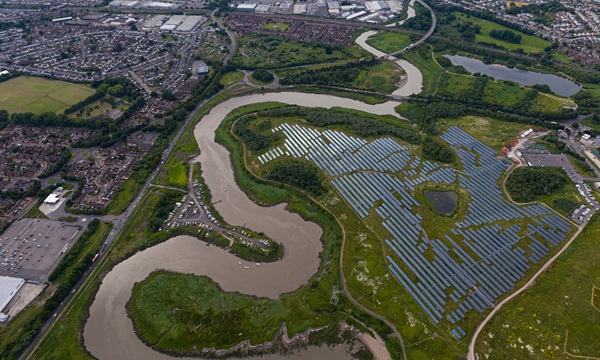
- The Lamby Way Solar Farm celebrated its fifth year, having generated more than 41GWh of clean energy.
- Major upgrades to council buildings, including energy‑efficiency improvements and heating system replacements.
Homes and communities
- Delivery of 129 new low‑carbon council homes, with more than 100 additional private homes retrofitted through the ECO4 partnership.
- A successful ‘Switch Together’ solar scheme enabling residents to collectively purchase solar panels at a reduced cost. The scheme resulted in 470 installations across the Cardiff Capital Region and stimulated £3.9m of spend by participating residents.
Behaviour change and leadership
- More than 1,600 council staff completed climate‑related training, including 169 who were certified as Carbon Literate.
- More than 118,000 trees have now been planted through the Coed Caerdydd programme.
To accelerate progress towards a carbon neutral future, the council has developed a Green Growth Proposition, which it describes as “a focused programme built around two major areas where the council can directly influence change”.
1. Expanding local renewable energy
Subject to funding and business case approval, the council will progress:
- A 14MW Lamby Way Solar Innovation Hub with battery storage and EV charging for its waste fleet.
- A city‑wide renewables pipeline, identifying sites suitable for large‑scale solar and wind investments.
- An expansion of the Cardiff Heat Network, with plans already in development to extend into the city centre.
- A programme to deliver solar PV and energy technologies on industrial and commercial buildings, starting with those that the Council owns.
2. Scaling up domestic energy retrofit
With around 91,000 homes across the city in need of retrofit, the programme also sets out proposals, subject to funding and business case approval, to:
- Expand the Switch Together collective buying scheme (previously known as Solar Together) to increase installation of domestic solar energy systems, with Phase Two of this initiative already active.
- Roll out a new Warm Homes for Health partnership with NHS colleagues to support residents whose health conditions are worsened by cold homes.
- Deliver a citywide retrofit engagement hub to give residents clear, trusted advice.
As part of the report, Cabinet will also consider whether to progress one significant element of the Green Growth Proposition by approving work with Welsh Government to develop an area based domestic energy retrofit pilot scheme.
The pilot scheme would enable households in fuel poverty to access funding for energy efficiency measures, installed by vetted installers, at no additional cost.
It will also explore ways to support other “able to pay” households to access the trusted processes and quality assured installers used by the public sector, in order to build greater confidence and certainty in achieving lower energy costs and more sustainable, healthier homes.
Independent research commissioned by the council shows that every £1 invested in retrofit could generate £5 in health and economic benefits, including reductions in NHS costs and improved wellbeing for residents.
The pilot would aim to provide real-world data on the health, social and economic benefits of retrofit work and provide justification for future upscaling – as well as stimulating wider uptake of retrofit measures and renewed interest from installers, providing quality assurance and ensuring controlled installation standards.
To enable community participation in climate action, the report also proposes that the council issues Local Climate Bonds, allowing residents and businesses to invest directly in local green projects and receive a fixed return. Up to £1 million could potentially be raised through this new mechanism.
16 local authorities in the UK have already used Local Climate Bonds to deliver over £18 million of investment in climate-related projects since 2020. Any scheme in Cardiff would be subject to further approval as part of the annual budget setting process in March 2026.