





A major review published in the journal Nature outlines how artificial intelligence and biotechnology could transform global crop production, helping to build more resilient food systems in the face of climate change, pests and population growth.
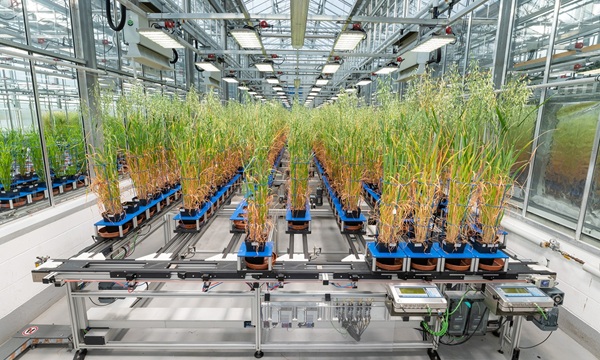
An international team of researchers from China, the USA and Europe, including Aberystwyth University, has set out a roadmap for integrating AI with genome editing, protein design, high-throughput phenotyping and omics technologies which analyse the genetic and chemical makeup of plants.
They say adopting these techniques would accelerate the improvement of crops that are more productive, sustainable and climate-resilient and could even lead to domesticating new crops.
Professor John Doonan, Director of the National Plant Phenomics Centre at Aberystwyth University’s Institute of Biological, Environmental and Rural Sciences (IBERS), said:
“Think of it like designing and building a bridge. We now have the tools to engineer crops with similar precision — combining biological insights with AI to build plants that can withstand drought, disease, and other stresses.”
The review highlights how AI can:
- predict the best combinations of genes for yield, nutrition and stress tolerance
- design novel proteins to enhance plant defences and performance
- integrate very complex datasets to guide smarter, faster breeding decisions
Professor Doonan added:
“This is about building resilience into our crops from the ground up. By uniting AI with cutting-edge biotechnology and sustainable farming practices, we can future-proof food production for generations to come.”
The work aligns with IBERS’ strategic focus on resilient crops and was supported by the Biotechnology and Biological Sciences Research Council (BBSRC) through its Resilient Crops programme, and by the Engineering and Physical Sciences Research Council (EPSRC) as part of its AI for Net Zero initiative.