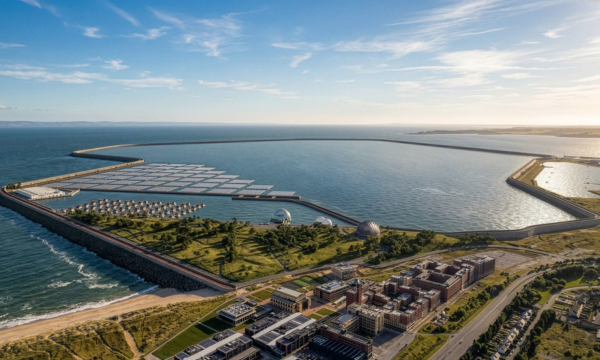





Associated British Ports (ABP) has secured a £64 million grant to complete the essential design and engineering work needed to build one of the first floating offshore wind ports in the UK at Port Talbot.
The new port will unlock an initial 4.5GW of floating offshore wind projects in the Celtic Sea – enough to power 6.5 million homes – following last year’s successful seabed leasing round by The Crown Estate.
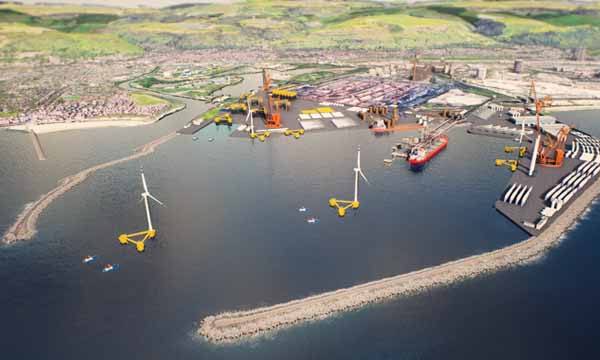
ABP expects that, once completed, the new port will support thousands of jobs and unlock more than £500 million in investment for Port Talbot.
The grant is from UK Government. Grant terms have been agreed with ABP and the funding will be subject to the outcome of the mandatory Subsidy Advice Unit referral and final approvals.
The Celtic Sea offers some of the best conditions for floating offshore wind (FLOW) in Europe. Unlike traditional offshore wind farms, floating turbines are based in deeper waters, where they can harness stronger and more consistent wind speeds.
The agreement between UK Government and ABP was marked by a visit by the Secretary of State for Wales, Jo Stevens, and Minister for Energy Consumers Martin McCluskey, to Port Talbot.
The visit marked a major milestone in plans to transform Port Talbot into a strategic industrial hub for floating offshore wind, providing the large-scale manufacturing, assembly and marshalling capacity required to deliver gigawatt-scale FLOW projects, ABP said.
It added that the development will ensure the region plays a central role in enabling projects awarded through the recent Celtic Sea leasing round and in securing long-term investment, supply chain growth and high-quality jobs across South Wales and the wider region.
Henrik L. Pedersen, Chief Executive Officer of ABP, said:
“Today’s visit marks real progress on the shared ambition between ABP and the UK Government to secure the infrastructure needed to deliver floating offshore wind at scale. Agreeing terms on government support is a critical step towards further ABP investment at Port Talbot and establishing the port as a cornerstone of the Celtic Sea floating offshore wind industry. This development would drive industrial regeneration, support thousands of skilled jobs and ensure Wales and the UK captures the full economic benefit of this emerging sector.”
During the visit, the Secretary of State and the Minister met ABP’s leadership team to review the next phase of development at Port Talbot, including plans that will support the delivery of the recent successful Celtic Sea Leasing Round 5 and help position the region as a world-class centre for clean energy manufacturing and deployment. The Secretary of State and the Minister also met ABP apprentices and graduate trainees to hear what this means for the future of those entering the workforce.
Secretary of State for Wales Jo Stevens said:
“This is a significant moment for Port Talbot and a major step forward for the growing clean energy industry in Wales. This investment will further cement Port Talbot as a hub of the industries of the future, and heralds the next chapter of jobs, and investment to the area.
“The UK Government has backed steelworkers and the community in Port Talbot with £100 million in direct support, and £500 million for the construction of a new Electric Arc Furnace ensuring that the town will manufacture clean steel into the future.
“Thanks to our investment, the work of trade unions and local businesses, and the dedication and spirit of local people – Port Talbot and the whole region have a very bright future.”
Developers with interests in the Celtic Sea have welcomed the progress made at Port Talbot.
Mark Hazelton, Gwynt Glas Project Director, said:
“We welcome today’s announcement from the Government to support the development of critical port infrastructure at Port Talbot. This is a vital step towards unlocking the immense potential of floating offshore wind in the Celtic Sea. The investment not only supports energy security but also lays the foundation for long term, highly skilled job creation in South Wales. Suitable infrastructure is essential to realising the transformative benefits this opportunity presents and we are pleased to see progress being made.”
Hugh Kelly, Co-Founder & CEO Simply Blue Energy said:
“Erebus welcomes the announcement by ABP and the Department for Energy Security and Net Zero towards progressing support for the continued development of Port Talbot as an offshore wind hub. Progress at Port Talbot directly supports our ability to plan and deliver floating offshore wind in the Celtic Sea. Port infrastructure for both test and demonstration activity and larger commercial scale projects is critical to efficient assembly and deployment, and this progress represents an important step in building the industrial backbone needed to deliver projects and provide a focal point for the emerging supply chain.”
Nikki Keddie, Head of External Affairs and Policy, Ocean Winds said:
“Ocean Winds welcomes the positive steps being taken to secure investment for development at Port Talbot. Strengthening local port infrastructure is essential, and we look forward to working with ABP and other stakeholders to ensure regional ports play a central role in supporting the build‑out of offshore wind in the Celtic Sea.”
The agreement between the UK Government and ABP was also welcomed by The Crown Estate, the manager of the seabed around England, Wales and Northern Ireland, as a further positive step towards realising the potential of the Celtic Sea.
Gus Jaspert, Managing Director, Marine at The Crown Estate, said:
“Establishing a new floating wind sector in the Celtic Sea through Round 5 could create thousands of jobs and economic growth in Wales, the South West and across the country. Ensuring onshore infrastructure is ready to support the successful delivery of this innovative technology is vital, making today’s announcement an important step on the path to us collectively bringing the Celtic Sea opportunity to life.”
Laura Dunn, Senior Associate at the Energy and Climate Intelligence Unit (ECIU), said:
“This will undoubtedly be welcome news for local people and communities. Floating offshore wind gives South Wales a chance to, once again, be at the forefront of industry, this time generating renewable energy that reduces our demand for gas and therefore reliance on international, volatile markets.
“Net zero means balancing our emissions to stop climate change, but it also means energy security and lifelong, skilled jobs in industries like this, in places like Port Talbot.”