Regeneratively-farmed seaweed grown off the Welsh coast has allowed farmers to reduce chemical fertiliser use on their land, while maintaining crop yield and quality.
Working with Pembrokeshire farmers, a two-year trial set out to demonstrate that locally-grown seaweed biostimulant – a naturally-derived product that stimulates plant nutrition processes – could compensate for reduced fertiliser rates; reduce carbon emissions from farming systems; deliver financial benefits for farmers; and maintain or increase yield, quality and soil health.
Led by St Davids-based community business, Câr-y-Môr, and funded by the Co-op Foundation’s Carbon Innovation Fund, the results on conventional grassland showed that when synthetic fertiliser was cut by 40% and seaweed biostimulant applied, the grass quality was maintained and the yield was up by 29%.
The yield and quality on trialled cereal and potato fields were also maintained when fertiliser was reduced by 25% and 29% respectively.
Lead author of the study Alma Joensen said:
“With increasing environmental pressures and scrutiny on nutrient management, more and more farmers are shifting their focus on to the soil and the health of life below ground. Reducing fertilisers and other chemical inputs is crucial to regenerating soil health, but often a really difficult step to take without compromising on yield and quality.
“These trial results are showing that seaweed grown just a few miles away can give farmers an immediate and practical way to increase nutrient uptake and reduce bagged nitrogen, all while maintaining output.”
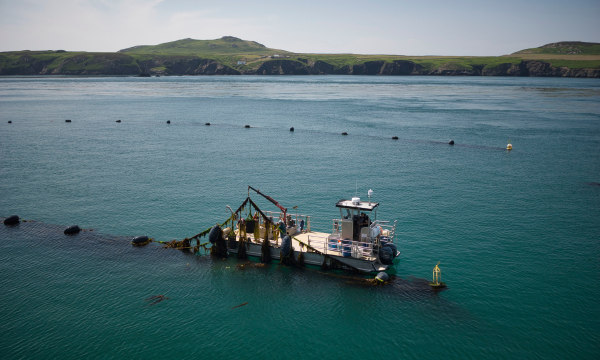
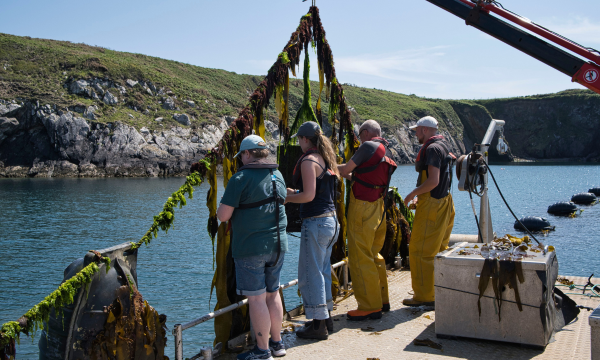
Sugar kelp, oarweed and furbellos, all native seaweeds, were harvested from Câr-y-Môr’s regenerative sea farms in the Ramsey Sound to make the biostimulant. Trials took place on six farms, from conventional agricultural land to organic farms, with one farmer seeing a 24% yield increase on their organic potato crops sprayed with liquid seaweed.
Agronomist Tony Little, who was part of the team conducting the trials, said:
“From the start, we have worked hand in hand with farmers considering reduced nutrient programmes. Seaweed biostimulant is helping them make the most of the nutrients already in the soil, and that will compound over time.
“That's important for the environment in terms of reducing agripollution and the carbon emissions associated with imported fertiliser production. At the same time, it helps farmers meet their obligations under the new Agripollution Regulations and can play a part in reducing the economic impact of fertiliser price volatility.”
Conducting the trials on working farms, rather than at a research centre means Câr-y-Môr’s findings are directly applicable in a commercial farming context.
Trial farmer Nicholas Evans from Crug Glas said:
“Yield is king, really. We want to try and get as much off our fields as we can. If we’re cutting fertiliser, we need to know that yield won’t suffer. And that’s where we think these biostimulants come in and de-stress everything.”
Neighbouring farmer Mark Evans from Upper Harglodd added:
“If we can improve the silage or the grazing, or even give long-term benefits to the soil – if we can benefit where it all starts, it’s going to set us up for a better future hopefully.”
Now with these positive trials as evidence, Câr-y-Môr is scaling production of biostimulant from its new seafood and seaweed processing facility just outside St Davids – the first dedicated seaweed biorefinery facility in Wales – in turn creating more jobs for its community, and allowing further, more extensive trials to take place.
The community business sees the seaweed biostimulant as an integral part of the regenerative system it’s creating, where land, sea, food, and livelihoods are all connected.
Director Dominic Burbridge said:
“The biostimulant is produced from seaweed grown on Welsh regenerative sea farms, where kelp captures excess nutrients and shellfish filter seawater as they grow. After harvest, the seaweed strengthens soil health on land, reducing the risk of nutrient runoff at source, and some shellfish are sold for food, while others continue their ecological function to be redeployed into rivers and estuaries as natural water filters.
“This integrated approach, linking marine cultivation, sustainable food production, and freshwater restoration, is now being explored through a river restoration project with the Marine Conservation Society in the Cleddau River, demonstrating how regenerative sea farming can deliver benefits across community, nature and climate.”
The full Liquid Seaweed Biostimulant Trials Report can be found here.