






Wally's Delicatessen has been a landmark in Cardiff city centre since 1981. Now the current owner, Wally's son Steven Salamon, has written a book about his family's story of persecution and escape from Nazi Europe, as well as the founding and evolution of the family store.
This extract is taken from the book, From The Anschluss to the Arcades.
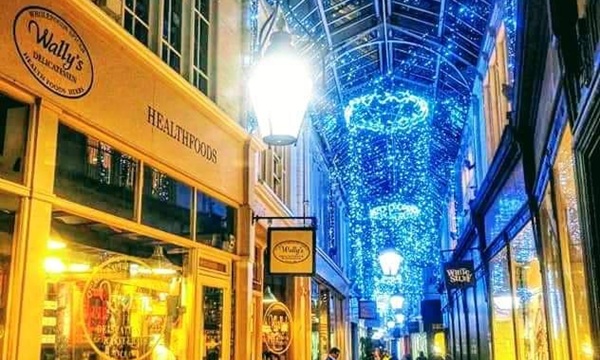
It is 76 years since my grandparents first welcomed customers to Bridge Street Stores, 44 years since an exhausted Wally, David and Tric mopped up spilt honey the night before opening Wally's, and 32 years since I joined the business. Wally's is now a Cardiff institution. It has received many awards, most notably Cardiff Life Retailer of the Year 2014 and Cardiff Family Business of the Year 2017, among many others. It is loved by its regular customers and visitors to Cardiff alike.
My children still enjoy frequent reminders of this. “I will never tire of people's reactions when they hear my grandfather was Wally, or the tingle of pride I feel when I see a stranger walking around Cardiff with a Wally's bag,” says Ben.
While Wally's has undergone some huge changes over the years, its appeal lies in its timelessness. This is embodied not only in the shop's signage and old school interior, but also by the long-serving staff who provide continuity and a consistent welcome to the shop's many regulars.
Dad would always greet customers with a smile and a “Sir” or “Madam”; that is how we still greet customers. The style is quite formal, even old fashioned, but I'm sure it is appreciated.
It's not by chance or habit that I keep so much of Dad's original vision for the store intact. Wally's is Dad. I know this will always be the case, and do not fight it. Instead, I embrace it and fill the shop with markers of our heritage, be it photos on the wall, the style in which we conduct business, the stories we tell or the culture we create.
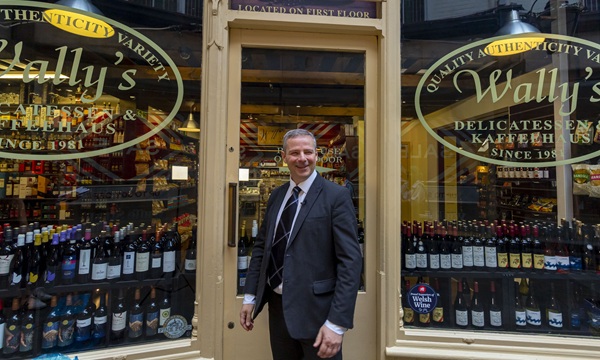
I wonder what character traits I have inherited from my father and grandfather. Undoubtedly, their experiences will have shaped their outlook and behaviours, some of which will be passed on to me. I don't believe, however, that I have any “inherited trauma” – a feature affecting some second- and third-generation descendants of Holocaust survivors. Studies have shown that the trauma experienced by Holocaust survivors may be passed down to future generations, affecting them psychologically and behaviourally. This can be reflected in anxiety, depression or a tendency to worry that their parents’ trauma could be repeated. If anything, I would say that being the descendant of Holocaust survivors has been a source of strength and resilience for me.
The one thing I sometimes wish I had not inherited from Dad is his work ethic! I am a workaholic like him, often to the detriment of my personal life. But of course, that is at the core of what has made the business successful and enduring. There is a lovely photo of Dad hanging on the stairs to the kaffeehaus, and I always say he is still checking that I’m working hard.
After Dad died, I had to deal with his death while striving to keep things running seamlessly, and I had to show the world I could run the shop as well as my father had, now that he was gone. Having sole responsibility for everything, all the results of my decisions and all the risks on me was a huge challenge. As Michelle says:
“The shop is not just successful because it's Wally's; it takes a huge amount of work and effort to keep it that way.”
Retailing – buying and selling – is easy; everything else is hard. I sometimes feel that I'm not a retailer but a maintenance manager, and at other times a personnel manager. When employing so many people, you must deal with their issues and understand their domestic situations. And when staff leave, it's always upsetting and difficult; staff retention in the shop has been excellent over the years, although in the kaffeehaus it's more difficult due to the age and ambitions of the staff.
Throughout it all, I have experienced highs and lows, stresses and elations, from opening new businesses to letting staff go (thankfully only twice for disciplinary reasons). My grandfather, father and I have had to contend with economic, social and political shocks – post-war depression and rationing; three day weeks and power cuts; legislative changes and several bouts of inflation. I think all three of us faced these challenges in much the same way: with stoicism and a realisation that the only way through them was to put our heads down and work hard.
Like any food retailer, the shop has been subject to regular Environmental Health inspections over the years. I am pleased to have kept an extremely high food safety standard amid increasingly stringent regulatory requirements. Some years ago, the Guild of Fine Food Retailers (GFF) invited me to share my expertise in a working party set up to work out practical issues around the retail of perishable fine foods, resulting in me being credited as an industry advisor in the GFF’s Assured Code of Practice for Deli Retailing.
Today, the delicatessen and kaffeehaus have settled back into a dependable rhythm. Trade during the year is steady, and Christmas trading has been robust. I have recruited excellent staff in the delicatessen to replace those who have left, but many long-term staff remain. The employees in the shop nowadays tend to come from the local population rather than from immigrant communitie,s where my grandfather and father would have looked for staff. Perhaps that is because I do not have as close a connection with those communities as they had. But this also reflects the changing customer demographic. As immigrant communities have assimilated, the customer base is markedly more local than my grandfather and father would have experienced, with second- and third-generation immigrants adopting local cultures and eating more typically British foods.
The availability of staff for the kaffeehaus – a big problem following the pandemic and Brexit, as European workers returned home to their families for the lockdown and then found they couldn't return following post Brexit, border control changes – has improved. However, the staff are now supplemented by students from India and Asia rather than Europe.
Unlike the delicatessen, the Liquor Cellar did not recover so well after the pandemic. Trade did not return to pre-Covid levels and, despite trying everything to grow the business, things didn't improve, and it ceased trading in April 2024. With great sadness, I made Matthew and the other two staff redundant – the first redundancies I had made in my career.
There are still significant challenges to face, and I believe the full impact of Brexit on the business is just starting to be felt. Following Labour's victory in the General Election of July 2024 I would like the new government to alleviate some of the difficulties of importing goods from Europe. At the time of writing, a new UK-EU deal has been announced, and there is even talk of a pan -European single market, so I will watch that space with interest.
From The Anschluss to the Arcades is available in store at Wally's, priced £11.99. It is also available from Wally's online at www.wallysdeli.co.uk/hampers-and-gifts/book.html and from Amazon at https://www.amazon.co.uk/Anschluss-Arcades-Evolution-Family-Store