
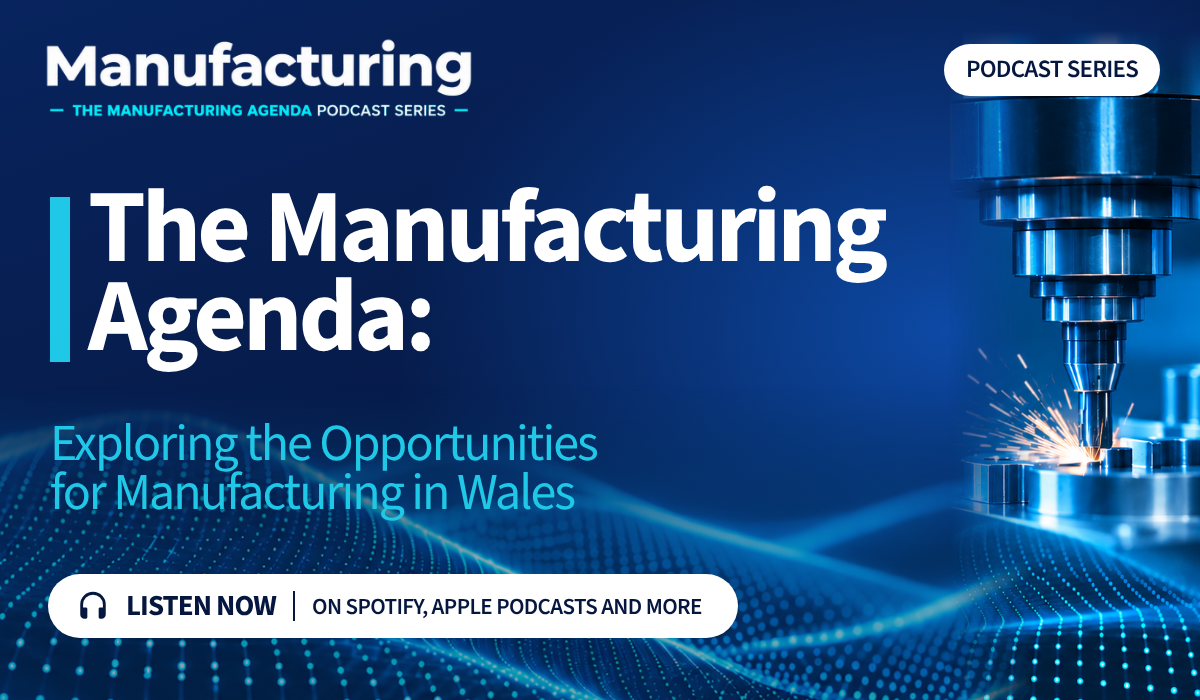
Business News Wales is launching a new podcast series, The Manufacturing Agenda, bringing together industry leaders, manufacturers and technical experts to explore the challenges, opportunities and innovations shaping the future of manufacturing in Wales.
The new series will examine the issues influencing the competitiveness and growth of Welsh manufacturing, covering everything from robotics, automation and artificial intelligence to research and development, exports, investment, workforce skills and industrial policy.
The opening episode, “Are Welsh Manufacturers Missing Out on Millions in R&D Tax Relief?”, explores whether manufacturing businesses across Wales are overlooking valuable financial support because they do not always recognise the innovation taking place within their own organisations.

Featuring Chris Alderson, Managing Director and Founder of Catalyst R&D, and Professor Paul Byard of the University of South Wales, the discussion examines why Wales receives a relatively small proportion of UK R&D tax relief despite its established manufacturing and engineering base.
Alderson points to HMRC statistics for 2023–24 which, according to his analysis, show Wales accounting for approximately 3% of UK R&D claims and just 1.6% of the total relief awarded, despite representing around 4.1% of UK employment.
He suggests that Wales could potentially be receiving significantly more support, particularly given the importance of manufacturing to the Welsh economy, although employment comparisons alone cannot establish the amount of additional relief for which businesses might qualify.
A central theme of the conversation is whether manufacturers fully recognise the technical work they undertake as potentially qualifying research and development.
Manufacturing businesses routinely adapt production processes, develop new products, modify machinery and overcome complex engineering problems. While not every improvement meets the eligibility requirements for R&D tax relief, some activities involve technological challenges that businesses may not previously have considered in this context.
Alderson explains that manufacturers often regard this work as part of their everyday responsibilities, particularly where engineering teams are focused on improving efficiency, reducing waste, resolving production difficulties or adapting to changes in components and materials.
Professor Byard, drawing on almost five decades of manufacturing experience, argues that innovation should be considered more strategically within manufacturing businesses.
He suggests that businesses should develop innovation plans alongside their wider business strategies, working closely with customers and suppliers to identify opportunities for product development, process improvement and commercial growth.
Rather than treating innovation as a series of isolated technical projects, he advocates a more structured approach connecting customer requirements with investment decisions, technical capabilities and workforce development.
The opening episode also examines changes to the R&D tax relief system, including additional administrative requirements, uncertainty surrounding eligibility and the impact of increased scrutiny on businesses considering making claims.
Both guests emphasise that the wider purpose of R&D support should be to encourage businesses to invest in innovation, improve productivity and strengthen their long-term competitiveness.
For smaller manufacturers, the potential benefits extend beyond tax relief itself. Better identification and management of technical development can help businesses understand where innovation is taking place, capture valuable knowledge from engineering projects and make more informed decisions about future investment.
The discussion concludes with a practical message for Welsh manufacturers: examine the difficult technical problems the business has solved, consider whether those activities involved genuine technological advancement and seek appropriate specialist advice where potential qualifying R&D may have been overlooked.
The Manufacturing Agenda will build on this opening discussion with future episodes exploring the technologies, businesses, people and investment decisions transforming manufacturing across Wales.
Through conversations with manufacturers, industry specialists, researchers and business leaders, the series aims to provide practical insight, share experience and encourage wider discussion about the opportunities and challenges facing one of Wales’s most important economic sectors.