
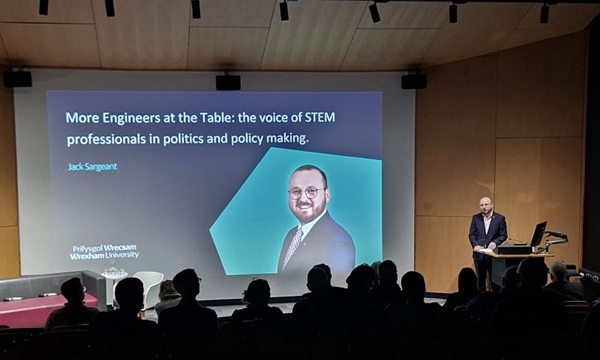
There was something particularly special about returning to Wrexham University to deliver a guest lecture as part of its Wrexham Talks Presents series. The subject was one that has shaped so much of my own journey: the voice of STEM professionals in politics and policy making.
I studied in Wrexham, having started my career as an engineering apprentice at what was then Deeside College, before going on to work in manufacturing. At the time, I could not have imagined that the experience I gained on the shop floor would one day help shape my approach to public service and government.
Returning to speak about that journey, and the contribution engineers can make to the decisions that shape our country, made the occasion especially meaningful.
It was also a pleasure to see some familiar faces in the audience, including former lecturers from Wrexham, as well as Nick Tyson, Vice-Principal and Director for Business and Partnerships at Coleg Cambria. Their presence was a reminder of the important role that colleges, universities and teaching staff play in developing the skills and confidence of the next generation.
The audience brought together senior politicians, representatives from industry, including Make UK and the North Wales Regional Skills Partnership, and students studying engineering at Master’s level. It was an encouraging mix of people from politics, education, manufacturing, engineering and the wider community.
During my time in the Senedd, including as Minister for Culture, Skills and Social Partnership, I saw first-hand how important decisions are made. I also became increasingly aware that people with practical engineering and technical experience are not always represented around the tables where those decisions take place.
That matters.
Whether we are talking about advanced manufacturing, artificial intelligence, renewable energy, nuclear power, transport or building the homes our communities need, the challenges facing Wales and the rest of the UK are increasingly technical. We need people who understand how things work, how systems fit together and what it takes to turn an idea into something real.
Engineers bring a valuable perspective. They are trained to identify problems, test assumptions, find solutions and continually improve. Those are qualities that can make a real difference to public policy.
But I am not arguing that engineers have all the answers, or that one profession should replace another. Good government needs a range of experience, including legal, social, economic and community perspectives. Technical knowledge must sit alongside democratic accountability and an understanding of the people affected by decisions.
The point is that we need a better balance.
North Wales provides some excellent examples of why this matters. From Airbus’s world-leading Wing of Tomorrow programme in Broughton to the research and innovation taking place at AMRC Cymru, we have engineering expertise that should be central to conversations about our economic future.
We also have opportunities in energy, construction, digital technologies and advanced manufacturing. But these opportunities will only benefit our communities if we make the right decisions about investment, infrastructure and skills.
That means listening to employers, colleges, universities, apprentices and the people already working in these industries. It means understanding the specific needs of our regional economy rather than assuming one approach will work everywhere.
One of the most valuable parts of the lecture was the question-and-answer session. It was there that the discussion moved from why engineers should have a stronger voice in policymaking to what we could actually do to make it happen.
I was asked what practical step could be taken to give engineers and STEM professionals a more visible role in shaping government policy.
My suggestion was straightforward: governments should create more opportunities for experienced engineers from industry to work inside government departments on secondment.
Governments already draw on expertise from outside the civil service. We should do more to bring experienced engineers into departments, giving policymakers direct access to the knowledge and practical experience of the people working in those sectors.
This would not mean engineers taking over decisions, or replacing the important work of civil servants. It would mean giving departments access to people who understand the realities of manufacturing, infrastructure, technology and the industries on which our economy depends.
It could help policymakers understand the practical implications of their decisions, identify challenges earlier and develop policies that work not just on paper, but in the real world.
There would be benefits for both sides. Government would gain access to valuable technical experience, while engineers would gain a better understanding of how policy is developed and how they can contribute to it.
It is an idea worth exploring, particularly in Wales, where our industrial future will depend on getting the relationship between government, education and employers right.
One of the messages I wanted to leave with students at Wrexham was that their expertise does not have to stop at the workplace. Engineers and STEM graduates should feel confident contributing to public debate, engaging with politicians, giving evidence and helping shape the policies that affect all of us.
You do not need to become a politician to influence politics.
My own journey began with an interest in engineering and a practical route into work. It eventually took me into public service, but the lessons I learned as an apprentice have stayed with me throughout.
I hope the lecture encouraged some of the students who attended to think differently about where their skills might take them.
Wales has extraordinary engineering talent. We should be proud of it, invest in it and, crucially, make sure it has a voice when decisions about our future are being made.
We need more engineers at the table – not because they have all the answers, but because Wales will make better decisions when their experience and expertise are part of the conversation.
Jack Sargeant was the Welsh Labour Senedd Member for Alyn and Deeside until May. He served as Minister for Culture, Skills and Social Partnership in the Welsh Government. A time-served engineer with a degree in industrial engineering, before politics he worked as a machinist at an engineering services company and as a research and development engineer with Atlas Copco.