Day 3 – Monday 3 November 2021
Wednesday was “finance day” at COP26, and it got off to a sobering start when US climate envoy John Kerry at a breakfast briefing, said the world had only a 60 per cent chance of reaching the goal of capping global warming rise in average temperatures at 1.5C.
Kerry said the good news was that an estimated 65 per cent of the global economy was now covered by implementable climate change plans.
Convening the largest ever meeting of finance leaders on climate change, Rishi Sunak set out the UK’s “responsibility to lead the way” and unveiled his plan for the UK to be the world’s first net zero aligned financial centre, calling for other countries to follow suit.
Under the plan there will be new requirements for UK financial institutions and listed companies to publish net zero transition plans that will detail how they will adapt and decarbonise, as the UK moves towards to a net zero economy by 2050.
The Chancellor hailed the progress made to “rewire the entire global financial system for net zero” under the UK’s leadership of COP, and revealed that over $130 trillion – around 40% of the world’s financial assets – is now being aligned with the climate goals in the Paris Agreement, including limiting global warming to 1.5C.
Sunak also announced £100m for a Taskforce on Access to Climate Finance, making it easier for developing countries to access finance for their climate plans.
Day 3 at COP26, with its focus on finance and the unimaginable sums needed to deliver global climate solutions, also saw the UK Government launch a call to action for British exporters to go green.
UK Export Finance, which helps businesses transitioning to or exporting renewable goods to win contracts overseas, is encouraging businesses across the UK to take part in the green industrial revolution.
The Government estimates that green trade will be worth £1.8tn by 2030, delivering up to £170bn of export sales in goods and services for the UK by 2030.
In June, UKEF launched a partnership with Offshore Renewable Energy (ORE) Catapult to promote the expertise of UK offshore wind companies abroad.
Part of a clean energy industry cluster at the Port Of Milford Haven, ORE Catapult’s Marine Energy Engineering Centre of Excellence (MEECE) is a multi-million-pound collaboration with Welsh universities.
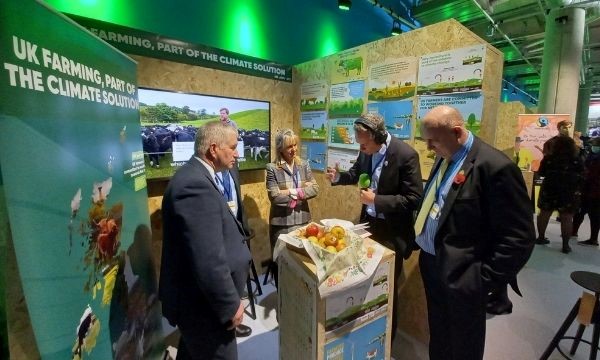
Apart from finance taking the limelight on Wednesday, Welsh farming was strongly represented at COP’s global agriculture forums.
John Davies, President of NFU Cymru, who is at COP26, told Business News Wales, that farming in Wales can play a big part in delivering climate solutions.
“The evidence is that our industry can sequester carbon, yes we create some climate change scenarios, but we sequester as well, unlike most industries,” said Mr Davies.
“We launched our ambition to achieve net zero by 2040 some two or three years ago now. We divided up the task into three sectors – productivity, sequestration, and renewables and innovation . And we’ve allocated the amount of carbon we’re going to reduce in each of those sectors.”
“Here at COP26 we’ve heard how the bar can be raised again. We’ve been doing a lot of work already on how seaweed and kelp additivesin cattle feed can reduce methane emissions. But we’ve heard today from new research in Canada, how that approach can reduce those emissions by up to 90%, and that would be a real game changer.”
NFU Cymru’s chief said the opportunities for Wales in the new green farming economy, depended on “getting future farm policy in Wales right” and “using scientific data and evidence to drive policy going forward.”
“It’s about having that vision and ambition to lead the world in sustainable food production, in line with nature and biodiversity.”